Themes
This section covers various topics or themes related to Australian Wars and Resistance and attempts to address questions that typically arise. Each section provides some points that should be considered in relation to the subject, and some recommended reading. In some cases researchers have provided articles addressing the topic for this website.
Points to Consider
Australia has a unique environmental and cultural context. We would not expect wars here to look the same as in other parts of the world. The cultures of Britain and Aboriginal and Torres Strait Islanders were very different. Because of this, the conflict was asymmetrical in many ways.
There is a difference between what is declared, claimed or stated and reality. If a war is undeclared or unofficial and there is no treaty or agreement, we can only determine that it happened, and when and where, and describe its characteristics through the real events that made it up.
- How can we identify when and where war starts and ends if there are no official declarations or agreements?
- How can we differentiate one war from another, in time and space?
- What would “war” look like in the Australian context?
- What about colonial conflict in Australia is similar to or different from conflict in other parts of the world?
- What are the main canonical theories and definitions of war? Who developed these theories and definitions, and where? To what extent does colonial conflict in Australia accord with these?
- What makes the difference between a violent action being an isolated incident, considered a crime or individual transgression in either colonial or Indigenous culture, and being an action within a war?
Recommended Reading
- Bosio, N. (2020). What is war? Defining war, conflict and competition. Australian Army Research Centre. https://researchcentre.army.gov.au/library/land-power-forum/what-war-defining-war-conflict-and-competition
- Callwell, C. E. (1906). Small wars: Their principles and practice (3rd ed.). His Majesty’s Stationery Office. https://www.history.navy.mil/research/library/online-reading-room/title-list-alphabetically/s/small-wars-their-principles-and-practice.html
- Clausewitz, C. von. (2006). On war (J. J. Graham, Trans.). Project Gutenberg. https://www.gutenberg.org/cache/epub/1946/pg1946-images.html (Original work published 1832)
- Clausewitz, C. von. (2015). Clausewitz on small war (C. Daase & J. W. Davis, Eds. & Trans.). Oxford University Press.
- Perkins, R., Gapps, S., Murray, M., & Reynolds, H. (Eds.). (2025). The Australian wars: The truth about the bloody battles fought to establish the nation . Allen & Unwin.
- Reynolds, H. (2013). Forgotten war. NewSouth Publishing.
Points to Consider
- What is the difference between strategy and tactics?
- What strategies and tactics did colonists and Indigenous people use, and how did they differ?
- What were the main advantages and disadvantages of each side?
- How did they use the environment and terrain?
Summary
Strategy and Tactics In Australian Wars contributed by Ray Kerkhove, 2026.
Recommended Reading
- Callwell, C. E. (1906). Small wars: Their principles and practice (3rd ed.). His Majesty’s Stationery Office. https://www.history.navy.mil/research/library/online-reading-room/title-list-alphabetically/s/small-wars-their-principles-and-practice.html
- Kerkhove, R. (2023). How they fought: Indigenous tactics and weaponry of Australia’s frontier wars. Boolarong Press.
Points to Consider
- Did Aboriginal and Torres Strait Islander people use guns in the Australian Wars and resistance?
- Why / why not?
- How could they obtain guns?
- What advantages or disadvantages did guns, or spears, shields and nullas have?
- How did weaponry on each side change over time?
Summary
Contributor: Ray Kerkhove (adapted from How They Fought)
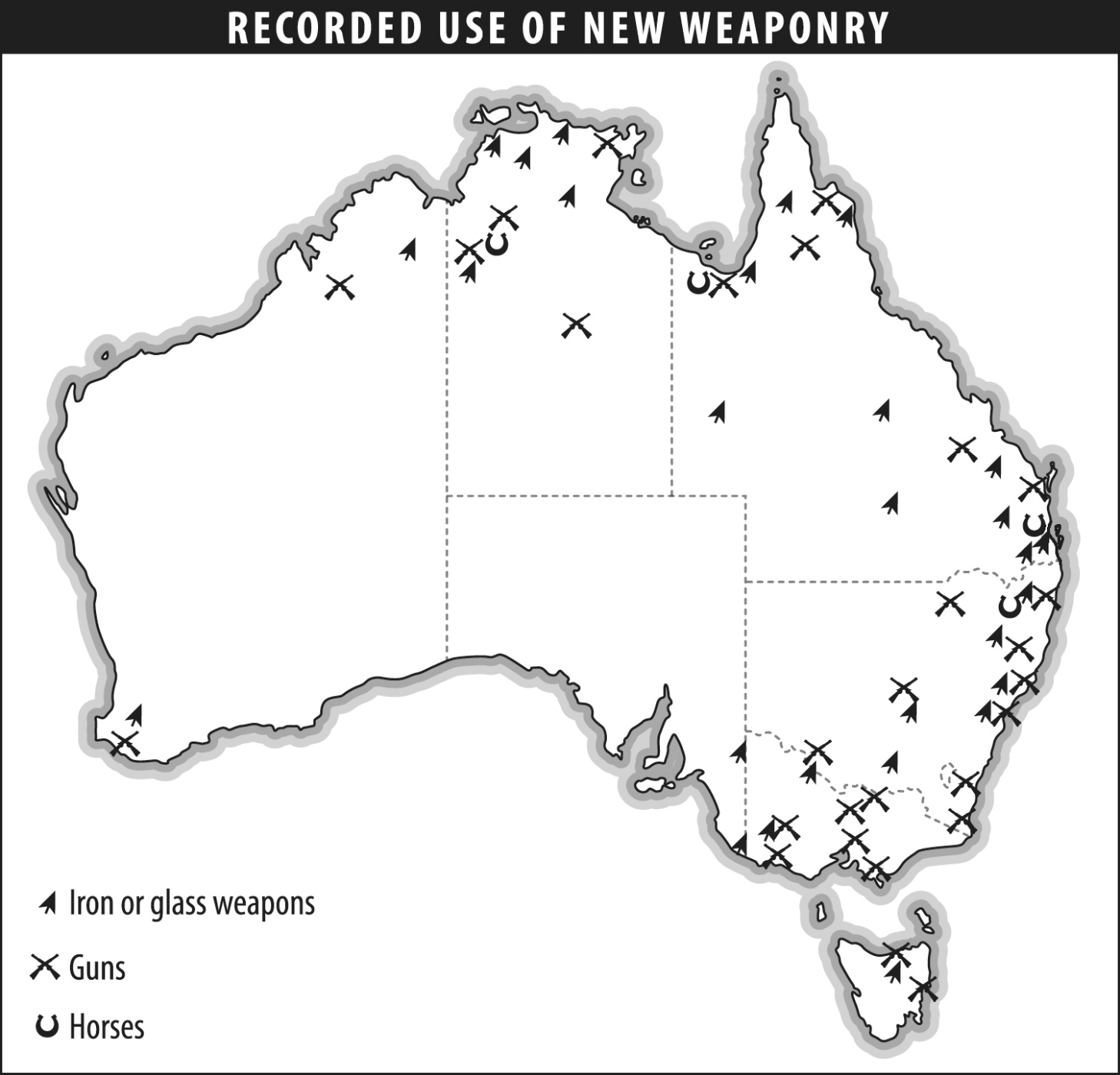
Firearms were initially not a great advantage for Europeans during the Frontier Wars. Most Australian spears had an equal or superior range to the firing of a European musket. Aboriginal warriors were able to toss these and other projectiles (clubs, tomahawks and fighting boomerangs) with great accuracy, silence and unpredictable trajectories. Also, Aboriginal warriors came equipped with dozens of spears each, tossing them in volleys whilst musket-users were busy reloading their weapons. These disadvantages of muskets are shown in the relatively mild tallies of early First Nations/ European skirmishes.
However, once European firearms advanced with repeating rifles in the 1860s, it became possible for even a few well-armed settlers to inflict devastating tolls, despite being vastly outnumbered. For this reason, most Aboriginal fighters became reluctant to meet settlers in open battle and relied increasingly on stealth and surprise one-off assassinations.
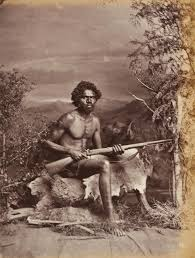
Several factors limited First Nations access to guns. Firstly, legal measures restricted firearms being traded en masse to Aboriginal people. Secondly, settlement expanded so rapidly in Australia that it often overtook the time required to master the new technology or acquire sufficient arsenals (most Australia being seized in 50 years – 1830-1880 - versus the 300 years invasion of North America). Finally, the only source for firearms for Aboriginal warriors was a hostile one: British settlers. This contrasts with North America, where various enemies of American settlers (French, English and Mexican traders) were eager to sell large quantities of guns to First Nations groups. By contrast, Aboriginal fighters mostly had to steal whatever guns they required.
Despite all these disadvantages, accounts of guns being used against settlers occur in most parts of Australia. Beginning in the 1810s and through to the 1940s, firearms were often stolen and used in raids or in attacks on cattle. In the Northern Rivers and New England districts of NSW and in the Kimberley region of WA, many First Nations attacks involved guns. For NSW, this was especially so between the 1840s and 1860s. One report from this area in 1860 complained that ‘the natives are now all armed with firearms and attack in ambush.’ In northern Queensland and the Kimberlys, some warrior-leaders even stole bullet moulds and cast their own bullets.
If First Nations peoples could not obtain firearms, or were unfamiliar with how to use them, they would instead resort to destroying or evading firearms. They developed many tactics for doing this: plugging up portholes; bending and breaking gun muzzles; dampening gunpowder; and removing all musket balls. Sometimes entire arsenals were destroyed. Warriors became adept at always staying just out of the range of fire; attacking between musket reloadings; luring settlers into exhausting their ammunition or otherwise jumping between trees and boulders to shield themselves as they advanced.
Iron provided another settler advantage. Steel swords, sabres, cutlasses, knives and bayonets were at times used against First Nations peoples. For instance, in 1827, police attacked Tasmanian groups using bayonets.

Although First Nations peoples did not know iron technology until the arrival of Macassar traders and Europeans in the last few centuries, they made concerted efforts to procure large quantities as soon as they realised its efficiency. Even the smallest European outposts and camps had iron objects constantly removed by Aboriginal peoples. Iron was also salvaged from dumps, drays and shipwrecks.
In what has been called ‘Australia’s Iron Age’, iron tools and fragments were rapidly traded across the continent. They were beaten and shaped into a range of new weapons. These included nail-headed clubs, sheep shear-headed spears, pronged wire and spike-headed spears, and tomahawks fashioned from horseshoe fragments. One of the most distinctive new weapons across northern Australia was the ‘shovel-nosed spear’ – a very deadly spear fashioned from the inner section of European shovels.
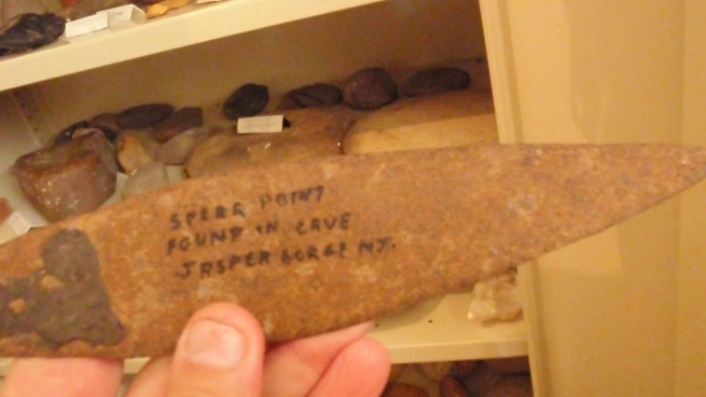
Iron weapons were stockpiled for use against settlers, and to more effectively kill or wound horses and stock. The decimation of stock was partly an adaptation to decreasing local game but was also at times conducted to deplete the economic base on which settlers survived.
Further Reading
- Anon., ‘Aboriginal curios – Victoria River’, Evening Journal (Adelaide), 14 November 1895, p. 2. Trove
- Anon., ‘The Battle of Rolling Bay’, Daily Telegraph (Sydney), 14 March 1910, p. 6. Trove
- Anon., ‘Inquiry into the circumstances attending the deaths of a number of natives on the Murray’, South Australian Register, 25 September 1841, p. 3. Trove
- Anon., ‘Murders by blacks’, Capricornian (Rockhampton), 26 November 1892, p. 37. Trove
- Anon., ‘Outrage by blacks’, Dubbo Dispatch and Wellington Independent, 14 June 1895, p. 4. Trove
- Allen, Harry, 2011, ‘Thomson’s spears: Innovation and change in eastern Arnhem Land projectile technology’, in Yasmine Musharbash and Marcus Barber, eds., Ethnography & the Production of Anthropological Knowledge: Essays in Honour of Nicolas Peterson, Canberra: ANU Press, p. 76.
- Clayton-Dixon, Callum, 2019, Surviving New England – A History of Aboriginal Resistance and Resilience through the First Forty Years of the Colonial Apocalypse, Armidale: Anaiwan Language Revival Program.
- Harrison, Rodney, 2020, ‘Australia’s Iron Age: Aboriginal post-Contact metal artefacts from Old Lamboo Station, Southeast Kimberley, Western Australia’, Australasian Historical Archaeology, Vol. 20, pp. 67–76.
- Jones, Philip, 2007, Ochre and Rust: Artefacts and Encounters on Australian Frontiers, Kent Town: Wakefield Press, pp. 91, 115, 119, 122-128.
- Kennedy, Edward B., 1904, The Black Police of Queensland: Reminiscences of Official Work and Personal Adventures in the Early Days of the Colony, London: J. Murray, pp. 153-154, 161.
- Kerkhove, Ray, 2023, How They Fought, Tingalpa: Boolarong, pp. 243-250, 253-261.
- Lewis, Darrell, 2012, A Wild History: Life and Death on the Victoria River Frontier, Clayton: Monash University Publishing, p. 110.
- Nettelbeck, Amanda, 2004, ‘Writing and remembering frontier conflict: The rule of law in 1880s central Australia’, Aboriginal History, Vol. 28, pp. 190-206.
- Organ, Michael K., 1993, Illawarra and South Coast Aborigines, 1770-1900, Report to the Australian Institute of Aboriginal and Torres Strait Islander Affairs, Canberra: Australian Institute of Aboriginal and Torres Strait Islander Affairs, pp. 76-77.
- Wallis, Lynley, 2020, ‘Wired: Aboriginal people and colonial communication networks’, 27 October, Archaeology of the Frontier, https://archaeologyonthefrontier.com/2019/10/27/wired/, accessed 10 May 2021.
- Wesley, Daryl, 2013, ‘Firearms in rock art of Arnhem Land, Northern Territory, Australia’, Rock Art Research, Australian Rock Art Research Association, Melbourne, Vol. 30:2, November, pp. 235-247.
Points to consider
- Did Aboriginal and Torres Strait Islander people use horses in Australian Wars and resistance?
- Why / why not?
- How could they obtain horses?
- What advantages did horses provide?
- What strategies or tactics were used against horses?
Summary
Contributor: Ray Kerkhove (adapted from How They Fought)
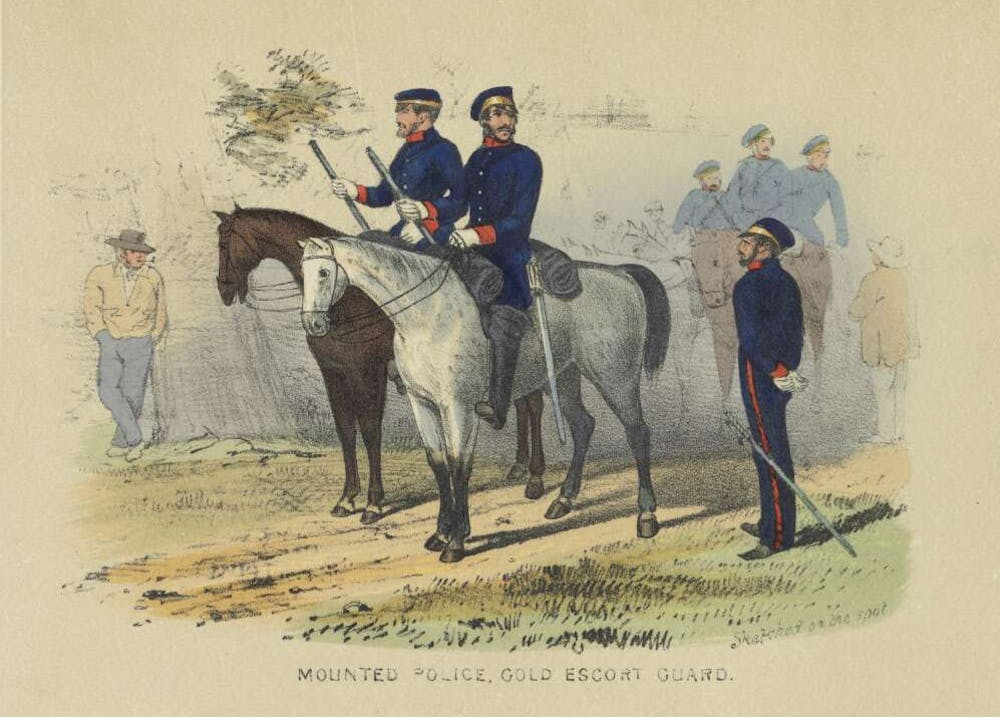
Horses posed a devastating challenge to the protocols of First Nations warfare, as all fighting was traditionally conducted on foot. Horses could over run warriors before they could defend themselves. Simply by being mounted on a horse, a European attacker commanded an elevated vantage point, especially useful in flat, rugged or scrubby terrain. Using horses, Europeans could swiftly reach and overtake armed warriors, chaotically disrupt camps, and speedily retreat. This advantage of speed and distance was one of the main ways Europeans could overcome the First Nations advantages of knowledge of country, stealth and evasion. Even a tiny group of horse riders could cause a great deal of damage. This advantage was ruthlessly exploited by squatters and Native Mounted Police. Almost all their operations were conducted on horseback.
Unlike North America, where wild horses had existed for three centuries and became a staple feature of Plains Indian warfare, Australian brumbies did not form herds till after the 1830s or 1840s, initially not expanding far beyond settled areas. This, and settler prohibitions against Aboriginal people owning (or even riding) horses, meant that First Nations use of horses during the Frontier Wars occurred rather late and sporadic. Even so, there were cases, particularly in northern Australia (for instance Jasper Creek NT and the Gulf of Carpentaria), where stolen horses were used either to attack Europeans or to steal their herds. Indeed, most use of horses by First Nations riders during the Frontier Wars was to steal and move European herds and flocks rather than to directly attack settlers.
When First Nations people did ride, either as native police or working as stockmen after the most intense conflict, they were recognised as exceptionally skillful riders. There was also the phenomenon of what have been called ‘Aboriginal desperadoes.’ These were Aboriginal men and women who operated as bushrangers with just a few associates, mostly in the 1860s-1920s. Although they were more concerned with robberies and other types of assault, their actions often included a rampage of vengeance against specific settlers. Some examples are Jimmy Governor (1875-1901), Yellow Billy (Hunter district), Black Harry (NSW) and Johnny Campbell (Kaiagaru, in southern Queensland).
The more usual manner First Nations groups dealt with horses was to ‘rush’ them. This meant stealthily untying or releasing them and driving them off. As Europeans heavily relied on horses for transport and tactical advantage, ‘rushes’ were very effective in bringing punitive expeditions to a halt. Sometimes the now-horseless party could then be gradually ‘picked off’ or harassed by hidden warriors as it scattered over the countryside, trying to locate the horses.
Many ‘rushes’ were conducted under the cover of darkness. This enabled horses to be driven a great distance away. It also forced the owners to either pursue their attackers on foot or abandon their mission altogether.
In other cases, First Nations warriors favoured the maiming and killing of horses. In a single raid against a prospecting party on the Roper River, eight horses were killed. Both in western Victoria and across the Northern Territory, horse-killing occurred regularly as a part of Aboriginal resistance. The greatest recorded slaughter occurred around south-western Queensland and north-western NSW, where sometimes all the horses on the stations were killed.
First Nations warriors knew how much Europeans valued and needed their horses. Therefore, they would sometimes use ‘horse killing’ as a taunt. For instance, on the Darling Downs, the tails of horses would be taken as trophies and ‘whisked in the first white man’s face they met.’ As horses were so valuable and crucial to European ways of life in Australia, horse killing and 'rushing', further inflamed antagonism.
As conflict intensified in a region, First Nations people strategically used their knowledge of country, such as rocky ground and wetlands, to deny colonists the advantage of horses. Resistance fighters in the Eumeralla War in western Victoria for example, used Budj Bim as a base and retreat because not only was it rich in food, but the ground was strewn with rocks and boulders making it inaccessible to horses.
Reading List
- Anon., ‘1877-1924: A journalist’s memories’, Brisbane Courier, 23 February 1924, p. 19. Trove
- Anon., ‘The Aboriginal desperadoes’, Armidale Chronicle, 18 August 1900, p. 5 Trove
- Anon., ‘Moreton Bay’, Bathurst Advocate, 3 June 1848, p. 1. Trove
- Anon., ‘Old bushranging days’, Mudgee Guardian and North-western Representative, 13 December 1900, p. 5 Trove
- Anon., ‘Outrage by blacks’, Dubbo Dispatch and Wellington Independent, 14 June 1895, p. 4. Trove
- Charola, Erika and Felicity Meakins, ed, 2016, Yijarni: True Stories from Gurindji Country, Canberra: Aboriginal Studies Press.
- Fijn, Natasha, November 2017, ‘Encountering the horse: Initial reactions of Aboriginal Australians to a domesticated animal’, Australian Humanities Review, Vol. 62, pp. 1-15.
- Kennedy, Alexander, 1924, ‘Northwestern Queensland – some recollections of pioneering days’, Graziers’ Review, 16 February 1924, p. 1292.
- Kerkhove, Ray, 2023, How They Fought, Tingalpa: Boolarong Press, pp. 261-268.
- Lewis, Darrell, 2012, A Wild History: Life and Death on the Victoria River Frontier, Clayton: Monash University Publishing.
- McNiven, I. J., Crouch, J., Richards, T., Dolby, N., Jacobsen, G., & Gunditj Mirring Traditional Owners Aboriginal Corporation. (2017). Kurtonitj stone house: Excavation of a mid-nineteenth century Aboriginal frontier site from Gunditjmara country, south-west Victoria. Archaeology in Oceania, 52(3), 184–197
- Mitchell, Peter, 2015, Horse Nations: The Worldwide Impact of the Horse on Indigenous Societies Post-1492, Oxford: Oxford University Press.
- Nunkiarry, George, 1996, ‘No bell ringing’, in Kimberley Language Resource Centre and Matthew Wrigley, 1996, Moola Bulla – In the Shadow of the Mountain, Broome: Magabala, p. 36.
Points to consider
- If killing was considered a crime would people who kill speak openly about what they or others had done?
- Why or why not? If they sometimes did or didn't, why in some cases and not others?
- If they could not speak openly, or officially, yet it was common knowledge, what words and phrases did people use to describe various kinds of colonial-Indigenous violence?
Summary
Euphemisms in Australian Colonial Conflict contributed by Dr Robyn Smith, Dr Chris Owen, Dr Bill Pascoe, Dr Jennifer Debenham, and Paul Desney.
Recommended Reading
References for each euphemism are included in the Summary