Themes
This section covers various topics or themes related to Australian Wars and Resistance and attempts to address questions that typically arise. Each section provides some points that should be considered in relation to the subject, and some recommended reading. In some cases researchers have provided articles addressing the topic for this website.
Points to Consider
Australia has a unique environmental and cultural context. We would not expect wars here to look the same as in other parts of the world. The cultures of Britain and Aboriginal and Torres Strait Islanders were very different. Because of this, historical conflict was asymmetrical in many ways.
There is a difference between what is declared, claimed or stated and reality. If a war is undeclared or unofficial and there is no treaty or agreement, we can only determine that it happened, and when and where, and describe its characteristics through the real events that made it up.
- How can we identify when and where war starts and ends if there are no official declarations or agreements?
- How can we differentiate one war from another, in time and space?
- What would “war” look like in the Australian context?
- What about colonial conflict in Australia is similar to or different from conflict in other parts of the world?
- What are the main canonical theories and definitions of war? Who developed these theories and definitions, and where? To what extent does colonial conflict in Australia accord with these?
- What makes the difference between a violent action being an isolated incident, considered a crime or individual transgression in either colonial or Indigenous culture, and being an action within a war?
What Is War?
The Classification Of Belligerancy
Contributor: Dr Sam White
Scientia Senior Lecturer in Military Law and War Studies, UNSW Canberra.
If you want to be legalistic about it, the state of war didn’t exist. Now, I think the Australian War Memorial is to honour Aboriginal Australians and other Australians who died defending Australia.1 (Prime Minister John Howard, 1998)
What is War?
What is war? The question appears deceptively simple. The Australian Constitution recognises war as something that allows for a shift in how Federal government works2; lawyers recognise it as a state of affairs where it is lawful to attack someone, and not just act in self-defence. Historians seem to happily recognise war when we see soldiers (as well as sailors and aviators) fighting across battlefields, governments mobilising armies, territory changing hands and, eventually, treaties bringing hostilities to an end. Australian military history is filled with conflicts that fit comfortably within this picture. The First and Second World Wars had identifiable belligerents, armies, campaigns and conclusions. Korea and Vietnam were undoubtedly s, even if there was no declaration. Iraq and Afghanistan are revered in the newly renovated Australian War Memorial for their combat operations. Whatever disagreements historians might have about their causes or character, nobody seriously doubts that they were wars.
The history of conflict on the Australian continent is harder to accommodate. There was no single declaration beginning the Australian Wars, no unified First Nations army and no treaty formally bringing them to an end. It occurred over century, with morphing technology and social expectations of what war was.3 At its core was the fundamental principles of war across history: territory, economics, fear of other people, or fear of threats.4 It is for this reason that a collective group of Australian historians, of which I am one, has sought to define war as: “a mortal conflict between two or more types of people over land, water, resources and the ability to exist as a people”.5 Violence accompanied the movement of colonists across the Australian continent, but often violence was meted out by private individuals rather than centralised military forces. Does the involvement of private individuals make it, somehow, not war? Does the inverse apply as well – that the involvement of troops somehow prima facie makes it war? Think, here, of my forebear Major James Morisset’s campaign in 1823 against the Wiradjuri.
It is not easy to answer, and the complexity is something that all are caught out by. War is a metaphor that brings with it a litany of baggage – and people who have modern experiences of it rightfully question its application to guerilla warfare two centuries ago. Yet war’s character has always varied enormously, and two centuries of colonisation of the Australian continent is hard to box into easily managed legal creatures. Soldiers, police, settlers and Aboriginal warriors participated in different combinations and at different times. There were attacks, ambushes, raids, reprisals, punitive expeditions, killings and massacres. But these are not legal terms; these are terms of politics.
Some periods of violence were sustained; elsewhere conflict was intermittent, localised or separated by periods of accommodation and relative peace. The difficulty is that our instinctive image of war is itself historically and culturally specific. If war is imagined principally through the experience of modern European states, then armies, uniforms, declarations, campaigns and battlefields begin to look like defining characteristics. Yet these things describe particular ways in which wars have been fought rather than necessarily telling us what war is. If a declaration of war is required for there to be war, then Australia has not had a war since 1942 (against Bulgaria6 and Thailand7). Iraq and Afghanistan’s exhibitions in the Australian War Memorial are legally unfounded. The current exhibition on Operation Kudu – Australia’s support to Ukraine – equally makes no sense, if John Howard’s requirement for a declaration of war is to be followed.
So, what is war, if it does not require a declaration? Here, lawyers and practitioners have disagreed for centuries. Considering lawyers first, Hugo Grotius, the doyen of international law, noted:
‘In treating of the rights of war, the first point, that we have to consider, is, what is war, which is the subject of our inquiry, and what is the right, which we seek to establish. Cicero styled war a contention by force. But the practice has prevailed to indicate by that name, not an immediate action, but a state of affairs; so that war is the state of contending parties, considered as such. This definition, by its general extent, comprises those wars of every description, that will form the subject of the present treatise. Nor are single combats excluded from this definition. For, as they are in reality more ancient than public wars, and undoubtedly, of the same nature, they may therefore properly be comprehended under one and the same name.’8
For Grotius, war is not simply the act of fighting. It is a state in which two or more sides are in conflict and prepared to use force against one another. This means a war can continue even when no actual fighting is taking place. His definition is deliberately broad. It includes wars between states, but can also include conflicts between individuals. For Grotius, the important point is the relationship of conflict between the opposing sides, rather than any particular battle or act of violence.
If lawyers do not wish to define war, then surely members of the Profession of Arms would. It is orthodox for both the practitioners and scholars of War Studies to look to Carl von Clausewitz as a useful starting point. Writing in the early nineteenth century, he famously described war as an “act of force to compel our enemy to do our will”.9 His more enduring insight was that war could not sensibly be separated from politics. War was a continuation of political intercourse, albeit through different means.10 Violence did not somehow escape politics once armies began fighting. It remained directed towards purposes that existed beyond the violence itself.
There are obvious limits to applying the thinking of a nineteenth-century Prussian officer to societies profoundly different from his own. Clausewitz was attempting to understand war in a particular moment of European intellectual and military environment. He also understood guerilla tactics, such as partisan operations and Cossack hit-and-run, to be war. Nevertheless, his insistence upon the political character of war remains valuable because it helps distinguish warfare from violence generally. Murder is violent, as are assault, riot and massacre, but violence alone does not make war. When does it become war? The problem has always been one that lawyers – rightly – back away from. Hedley Bull’s interpretation of war reinforces this view, where war is:
…organised violence carried on by political units against each other. Violence is not war unless it is carried out in the name of a political unit; what distinguishes killing in war from murder is its vicarious and official character…[.] Equally, violence carried out in the name of a political unit is not war unless it is directed against another political unit; the violence employed by the state in …the suppression of pirates does not qualify because it is directed against individuals.11
William Finlason confronted precisely this problem in 1868 when considering the use of martial law to suppress rebellion. He distinguished a riot from a rebellion not simply by the scale of the violence, but by the character of the threat and, importantly, the legal framework thought necessary to meet it:
And these words, riot and rebellion, indicated the scope of the powers of common law and of natural law respectively. Riot is, in its nature, casual, actual, and simple; and simple measures of resistance may suffice, and the simple powers of the common law may be sufficient. But rebellion, as it is more dangerous and deep-seated, so it is necessarily more difficult to deal with, and may require not only full liberty of attack, but, as it may be passive as well as active, may follow a policy of exhaustion and devastation rather than one of aggression or attack, even full liberty of attack may be insufficient to subdue it, and deterrent measures may be necessary, and the power of speedy punishment … Rebellion is war: that is the cardinal principle. War requires measures of war.12
Finlason's formulation is revealing. The boundary between ordinary violence and war was not simply a question of how many people were killed, how intense the violence became, or whether soldiers were involved. It also depended upon how the violence was understood: its organisation, purpose, persistence and, ultimately, the measures thought necessary to suppress it. In that sense, the classification itself carried political as well as legal consequences. Martial law, of course, is its own legal creature.13 Its declaration does not mean that a society is necessarily at war, just as its absence does not mean that a society is necessarily at peace.
But Finlason exposes the deeper difficulty: there is no single moment at which violence objectively and indisputably becomes war. War is a condition that must be identified from the character, purpose and accumulation of violence, rather than from the presence or absence of a particular legal declaration. Current Australian Army doctrine recognises as such:
[a]ll war is conflict, yet not all conflict is termed war, with the spectrum extending from ‘no conflict’ situations – like humanitarian relief – up to and including ‘total war’ between states. This reaffirms that conflict, at any level, is a competition of political and human will that can use violent and non-violent means to influence a diverse group of actors to achieve the political objective.14
This is where massacres become important. A single massacre may be capable of forming part of a war, although whether it is sufficient, standing alone, to establish the existence of one remains debatable. A sustained concentration of massacres, close together in space and time, presents a much stronger case. Several such events can demonstrate that violence has ceased to be episodic or merely interpersonal and has become a sustained means of coercion between identifiable groups. This accords with familiar understandings of war: force becomes the principal means of coercion; it is directed towards collective or political ends; it occurs between groups rather than merely between individuals; and it involves the deliberate application of potentially mortal force. In Clausewitzian terms, force is being employed to achieve political ends. In contemporary Australian military terms, force has become the principal means by which one group seeks to compel another.
Clusters of massacres therefore provide a useful means of identifying periods and regions of war. They allow concentrations of organised lethal violence to be distinguished both from isolated incidents and from other concentrations occurring at different times or places. Importantly, however, massacres are not themselves synonymous with war. Wars contain far more than massacres: raids, reprisals, ambushes, punitive expeditions, resistance, territorial displacement, coercive policing, military mobilisation and periods of relative quiet may all form part of the same conflict. A cluster of massacres should therefore be treated as an indicator of a state of war, rather than as a self-sufficient definition of it. Its significance must be validated against the wider historical context, including other recorded incidents of violence, patterns of mobilisation and resistance, the assessments of historians, contemporary evidence and, critically, Indigenous knowledges and accounts of the conflict.
These are, perhaps surprisingly, the same problems we face today. Modern International Humanitarian Law (IHL) largely avoids asking whether a situation is war at all. Instead, it asks whether the factual circumstances amount to an armed conflict, because that classification determines whether - and which rules of - IHL apply. The terminology has changed, but the underlying problem remains familiar: at what point does violence cease to be something less than armed conflict and cross the threshold into a qualitatively different legal condition? The ICRC itself describes legal classification as a process of determining, from the facts and the applicable legal criteria, whether a situation constitutes an international or non-international armed conflict.15
There is no universal casualty count (i.e. massacres) that answers that question – just look to Northern Ireland’s famously named ‘Troubles’. Nor is there a prescribed number of attacks, a particular weapon that must be used, or a declaration that transforms violence into armed conflict. Indeed, the legal position differs depending upon the parties involved. An international armed conflict may arise whenever there is resort to armed force between States, even if the confrontation is brief and casualties are limited (there is divergent opinion about this if the matter is purely law of the sea).16 Non-international armed conflict is more difficult: the violence must reach a sufficient level of intensity and the non-State party must possess a sufficient degree of organisation. These are factual assessments rather than numerical formulas. The law looks to the character of the confrontation as a whole rather than waiting for a particular body count to be reached. This is why the ICRC emphasises that classification rests upon facts and legal criteria, rather than upon the labels adopted by the parties themselves.
There is an intriguing continuity here with Finlason. His distinction between riot and rebellion was certainly the product of a very different legal order, and his invocation of martial law should not be confused with the modern law of armed conflict. Yet the conceptual difficulty is strikingly similar. Finlason was searching for the point at which ordinary law was no longer sufficient to describe or respond to organised violence: when a riot had become rebellion, and rebellion had acquired the character of war. Modern IHL asks a more carefully developed legal question, but it still confronts the problem of classification. Violence exists along a spectrum, while law necessarily creates categories.
Whose spectrum, then? Modern IHL is often critiqued for being too Eurocentric, and it is clear that modern issues of IHL flow from its ‘original sin’ – that it was written for Europeans, by Europeans.17 If the characteristics of European war become the test for the existence of war everywhere else, then societies organised differently can almost never satisfy it (and this is an institutional flaw in current international law that is exploited by non-European adversaries).18
That is particularly problematic in Australia. Before colonisation, the continent was occupied by many different peoples whose relationships to Country, law, authority, kinship and neighbouring communities were complex. Aboriginal Nations traded, negotiated access, recognised boundaries, shared legal spaces and maintained relationships carrying both rights and obligations. The use of the singular “Aboriginal law” can itself obscure this diversity. As Ambelin Kwaymullina has argued, Aboriginal legal traditions were in an important sense international traditions, involving relationships between distinct peoples rather than a single undifferentiated society.19
Violence existed within those relationships, but it should no more be treated as a single phenomenon than violence within European societies. Historical research has identified formal battles, raids, revenge attacks, ritual trials and other forms of confrontation.20 Others more closely resemble what a modern observer would readily recognise as collective warfare.21 At times, it could be a series of individual criminal acts; at other times a concerted campaign on Country.22 The complexity was recognised at the time, and found within the historical records. A micro-example is found in the works of Sir Charles Napier, who remarked:
‘Mr. Moore's assertion accuses Midgegoroo of three murders, Mr. Moore's account proves that Midgegoroo justly and meritoriously slew three invaders! These were the glorious deeds of a man defending his country against an unjustifiable invasion, an invasion made for the undisguised and unprincipled purpose of conquest; an invasion and seizure of territory committed in the most bare-faced manner’.23
Stephen Gapps establishes in Gudyarra that the Wiradjuri attitude to the conflicts at some point underwent a legal shift from one for one retributive justice applied only to colonial men24 to Gudyarra, all-out war that included attacks on what we would now title non-combatants.25 The same appears to have occurred with Palawa speaking peoples after decades of attacks only on male colonists. After prolonged campaigns, Palawa people finally started attacking women and children, which was followed by the final retaliatory push by the colonial government of Van Diemen's Land (Lutruwita/Tasmania).26
The distinctions are important because acknowledging Aboriginal and Torres Strait Islander warfare does not require characterising every violent encounter as war, and does not necessarily aim at the complete destruction of an opponent.27 They provide a means for discerning whether a violent act can be understood as an act of war, or not, depending on the circumstances. They also provide ways for describing unique and distinctive characteristics of warfare in the Australian context. At the Australian War Memorial, Miriŋu Dhäwu highlights how the settlement of grievances worked via a makarrata.28 Evidence of traditional conflict describes rules and practices intended to limit unnecessary death and injury. Large confrontations could result in surprisingly few deaths, although serious and lethal conflicts certainly occurred. One account described a battle as successful precisely because nobody had fallen: there had been considerable argument, but the spears were ultimately not thrown. Other accounts describe former opponents socialising shortly after a battle had concluded, apparently without the enduring hostility an outside observer expected. Colonists often noted that 'battles' settled differences and often were ceremonially followed by a corroboree. In 1878 Smyth wrote,
"When the fight is over, the wounded are well cared for. The animosity which influenced some of the more truculent of the warriors is forgotten or concealed, and not seldom help is given to the injured by both parties. Perhaps the day's work is concluded by a dance, and the reconciliation of the tribes completely effected..."29
In 1839 Rev. J. Orton recorded,
"It appeared that some disagreement had induced several tribes to assemble on the bank to the amount of from four to five hundred to settle their disputes by fighting and corroborees (or dances) according to their custom in such cases. Upon their meeting, a few spears were hurled but without any serious consequences, and this assemblage of sable savage warriors terminated their disputes by a succession of corroborees for several nights." 30
While there were cases where these ‘rules of war’ broke down, just as they have at times in other societies, and violence continued without reconciliation or exceeded accepted bounds, this is not to romanticise intra-Indigenous warfare or to suggest that conflict invariably followed prescribed processes of restraint and resolution. The historical and cultural record includes instances of severe, prolonged and destructive violence between Indigenous groups. The important distinction is between war as it was understood to be properly conducted and war as it was sometimes actually practised. Within modern IHL, this is called a problem of respect and compliance. Indigenous laws and customs could prescribe who might fight, for what purpose, against whom, by what means, and when violence should cease, without guaranteeing that those prescriptions were invariably observed.31 Departures from those expectations—including excessive, indiscriminate or continuing violence—should therefore not be treated as evidence that no normative system existed. Rather, such conduct might itself have been understood as the wrong way to conduct war.
There is a useful comparative point here. European traditions likewise distinguished, however imperfectly, between warfare conducted according to accepted laws, customs and conventions and the depredations of marauding forces engaged in indiscriminate killing, robbery, rape and pillage. European warfare repeatedly departed from its own normative ideals, sometimes catastrophically, but those departures do not lead us to conclude that European societies possessed no rules governing warfare. Neither tradition should be assessed solely by its worst historical departures from its own normative expectations. Recognising this distinction avoids both a romanticised account of Indigenous conflict and the opposite error of treating examples of brutality as evidence that Indigenous societies possessed no laws, customs or normative expectations governing warfare.
Those ‘rules of war’ were naturally different in pre-colonial Australia from the traditions that developed in Europe. The cosmological and kinship-based connections of Indigenous Australia produced their own normative frameworks governing the resort to violence, who might properly participate, against whom violence might be directed, the means by which it could be exercised, and the circumstances in which hostilities ought to cease and relationships be restored. The relevant question is therefore not whether Indigenous warfare conformed to European expectations of what war should look like, nor whether Indigenous peoples invariably complied with their own rules. It is whether Indigenous societies possessed normative frameworks through which permissible and impermissible forms of collective violence could be understood and distinguished.
This does not make such conflicts less real, or somehow create a gap that cannot be bridged. Our worlds are not too far removed. Rather, it illustrates the danger of assuming that war must always seek decisive victory, territorial conquest or the annihilation of an enemy. To hold so is, bluntly, historically weak and legally wrong. English law, in 1788, did not require it. In section four of the Introduction to the Commentaries, entitled ‘Of the Countries Subject to the Laws of England’ Blackstone describes the two types of conquered or ceded people.32 The first are those conquered in the Roman style, a right allowed by the ‘law of nature,’ or at least upon that of nations, he remarks.33 The second form of conquest, under the law of nations, were those of ‘infidels’.34 The tests for both was whether there was:
[f]ounded by a compact either expressly or tacitly made between the conqueror and the conquered, that if they will acknowledge the victor for their master, he will treat them for the future as subjects, and not enemies.35
The significance of Blackstone's test is easy to miss. Conquest was not simply victory in battle. It was the forcible alteration of a political relationship. There was a conqueror and a conquered; an enemy who, through express or tacit compact, became a subject. The object was not necessarily to destroy the opposing people, but to compel their submission to a new political authority. That tells us something important about what war could mean in 1788.
Blackstone was not concerned with defining war. He was concerned with conquest: the acquisition of authority over one political community by another through force. Yet that concept necessarily presupposed a prior contest between political communities. Conquest was not measured simply by casualties inflicted, the destruction of an opposing force, or victory in a decisive battle. Its defining feature was political. One people had, through force, been compelled to acknowledge the authority of another.
On that understanding, the Bathurst conflict presents an uncomfortable case of conquest in precisely the European legal sense. The Wiradjuri were numerous and organised. Warriors were called from across Wiradjuri Country; they fought collectively and in formation; they contested, regained and ultimately lost control of territory; and the conflict ended with Windradyne seeking peace.36 These are not offered as criteria for determining whether the conflict was a “war” in Blackstone’s mind. Blackstone was not interested in that question. Rather, they matter because they make the subsequent establishment of British authority lawful, under English law. Windradyne’s journey to Parramatta therefore matters. The colonial account sought to domesticate the encounter by presenting him as a criminal seeking pardon. But that description sits uneasily with Windradyne marching from Bathurst accompanied by some 150 Wiradjuri warriors and entering the Governor’s feast openly and unchallenged. If this was a capitulation, it was a remarkably public and political one. It looks less like the surrender of an individual criminal offender than the conclusion of an armed contest between political unities.
That characterisation is deliberately provocative. To say that conquest occurred is not to endorse conquest, nor to suggest that Wiradjuri sovereignty, identity or connection to Country somehow disappeared. It is to take European law seriously on its own terms. If British authority at Bathurst was established through conquest as Blackstone understood it, then the legal category cannot be invoked selectively. Conquest carried legal baggage. It presupposed a pre-existing political community capable of being conquered, a body of law governing that community, and legal consequences for the status of its laws and institutions after conquest. The uncomfortable question is therefore not simply whether the Wiradjuri were “conquered”. It is what follows if, according to the legal doctrine the British themselves brought to Australia, they were.
Seen in those terms, Blackstone's account sits remarkably comfortably beside Clausewitz's later description of war as an act of force intended to compel an enemy to do one's will. Both direct us away from the amount or type of violence, and towards its political purpose. War is not made war by a body count, or by military uniforms. Its defining feature is the use of organised force within a political contest: to resist authority, to impose it, or to compel another political community to accept a new state of affairs. That is why Blackstone matters to the Australian Wars. If we ask whether frontier conflict looked like a European battlefield, we are asking the wrong question. Given the extreme differences between British and Indigenous Australian cultures and the differences between European and Australian environments and populations we would not expect warfare to look much like it did in Europe. Even the English law brought to Australia did not make pitched battles, mass casualties or annihilation the measure of conquest. It looked to the political relationship produced by force.
The harder question is therefore much simpler: was political authority being contested through force?
If one people sought to extend its authority over Country, and another used organised violence to resist that authority, the absence of uniforms, declarations of war or spectacular battles does not resolve whether war existed. Nor does the fact that resistance was local, intermittent or sometimes limited in its lethality. On Blackstone's own logic of conquest, the critical transition was from enemy to subject - from resistance, to the acceptance of another's authority. That is precisely what makes the Australian experience so difficult. Where was that transition? Where was the express or tacit compact? When did First Nations peoples cease to resist as political communities and acknowledge the Crown as their political master? The assertion of British sovereignty answers what Britain claimed. It does not, by itself, answer what First Nations accepted.
Blackstone therefore brings us back to the central point. War is not defined by how much violence occurs, but by what the violence is for. Where organised force is used to impose, resist or determine political authority, we are very close to the thing that both eighteenth-century law and Clausewitzian theory understood to lie at the heart of war.
The question for the Australian Wars is not whether enough people died for us to use the word, or whether massed armies marched in formation, or whether there was a formal declaration or a treaty; it is whether they were fighting over who had the right to rule (per English law). There are therefore at least two issues concealed within the apparently simple question of whether Australia experienced war. The first concerns what happened. That is an historical problem. Evidence can tell us about the organisation of violence, its frequency and intensity, the communities involved, their objectives, the relationship between particular incidents and wider patterns of resistance, and the responses of colonial authorities. The answers will differ across time and place. Some episodes may comfortably be described as wars. Others will remain ambiguous. Still others are better understood through different categories altogether.
The second question concerns what we choose to call those events. That decision cannot be entirely separated from politics. It is ultimately a political question, not legal. It is also a question we must answer ourselves. As Professor Cameron Moore notes:
It is not enough to deflect this shame on to the British because it is Australians who have done these things, the doctrine of terra nullius grew from Australian cases rather than a British declaration, it is Australians who are in possession of Australia, and it is Australians who must take responsibility. British people live in Britain, on the other side of the world. British people did not come here, dispossess Aboriginal people, and then all go home. The original British settlers became Australian. They were my ancestors.37
It is for Australians to look to, and decide what we call this. Lawyers can only go so far. Yet this does not mean that war is whatever somebody politically decides it to be. Historical evidence places limits upon plausible interpretations. Nor does it mean that governments possess an exclusive authority to determine whether war exists. Indeed, modern international humanitarian law deliberately looks beyond labels in determining whether an armed conflict exists. Governments cannot necessarily escape legal obligations simply by refusing to use the word war. Why, then, would a sitting Prime Minister make a legalistic argument about the Frontier Wars if there is no basis for it? Well, perhaps because there is no set answer. Law is an easy shield to hide behind.
Public recognition is different from legal classification. Decisions about which conflicts become part of a nation's military history, which dead are understood as war dead, which violence is commemorated and which events are described as battles rather than disturbances inevitably involve judgements about the past. Those judgements can change. For much of Australian history, the dominant conception of warfare made the conflicts fought on this continent unusually difficult to see. Australians readily recognised war when the political community involved was the Australian or British state and the battlefield was overseas. Violence on the Australian frontier was more easily fragmented into episodes of disorder, criminality, policing, massacre and resistance. Sometimes those descriptions were entirely appropriate. Sometimes they may also have obscured the larger political relationship within which violence occurred. Sometimes what might be described as a 'crime' in isolation (such as murder), can be described as an act of war in a broader political context. Clausewitz does not provide a simple answer to the Australian Wars. Nor should he. What he provides is a useful reminder that the essence of war cannot be found in uniforms, declarations or battlefield formations alone. War is connected to political purpose. Once that is accepted, the political worlds of all participants must be taken seriously.
The Australian Wars therefore force us to ask not only how much violence occurred, but what that violence meant to those who participated in it. We need to ask who exercised authority, what was being defended or contested, how collective action was organised, and what participants were attempting to achieve. Those questions cannot be answered by definition. They require careful historical work, and the answers will not be uniform across a continent or across more than a century of colonial expansion. Perhaps that is the most useful answer to the question what is war? War is a category through which we try to make sense of organised political violence, but its boundaries have always been contested. Evidence can establish that violence occurred and illuminate its character and purpose. Law can impose particular thresholds for particular purposes. Historians can compare events and identify patterns. None of these processes, however, completely removes the act of judgement involved in naming a conflict a war.
In Australia that judgement has particular significance. The question is not simply whether frontier violence sufficiently resembled the wars Europeans, on the other side of the world, already knew how to recognise. It is whether we are prepared to understand that violence within the political situation in which it actually occurred, here in Australia.
-
Remarks concerning the Australian War Memorial (23 November 1998), archival footage reproduced in Matt Peacock, ‘War Memorial Battle over Frontier Conflict Recognition’, 7.30 Report (ABC Television, 26 February 2009) accessible https://www.nationalunitygovernment.org/content/war-memorial-battle-over-frontier-conflict-recognition ↑
-
Specifically, Australian Constitution section 51(vi); see Australian Communist Party v Commonwealth (1951) 83 CLR 1; Thomas v Mowbray (2007) 233 CLR 307. ↑
-
Roland, A. (1989). Technology and War: From 2000 B.C. to the Present by Martin van Creveld (review). Technology and Culture, 30(4), 1037–1039. https://doi.org/10.1353/tech.1989.0010 C 4 to C 5. ↑
-
Archer, C. I. (2002). World history of warfare. University of Nebraska Press. p 9. ↑
-
Commonwealth, Gazette, No 14, 14 January 1942, 79. ↑
-
Commonwealth Gazette, No 198, 20 July 1942, 1733; see further Moore, Cameron. Crown and Sword: Executive Power and the Use of Force by the Australian Defence Force (Canberra, ACT: Australian National University Press, 2017) p 216. ↑
-
The Rights of War and Peace, including the Law of Nature and of Nations. Translated from the Original Latin of Grotius. With Notes and Illustrations from Political and Legal Writers by A.C. Campbell, A.M. With an Introduction of David J. Hill, Assistant Secretary of State of the United States (New York: M. Walter Dunne, 1901), 17-18. ↑
-
Clausewitz, C. von, Graham, J. J., & NetLibrary, I. (2006). On war. Project Gutenberg. Book 1, Chapter 1, pp 2. ↑
-
Clausewitz, C. von, Graham, J. J., & NetLibrary, I. (2006). On war. Project Gutenberg. Book 1, Chapter 1, pp 24. ↑
-
Bull, H. (1977). The anarchical society: a study of order in world politics. Macmillan. 178. ↑
-
William Finlason, A Review of the Authorities as to the Repression of Riot or Rebellion: With Special Reference to Criminal or Civil Liability (Nabu Press, 2010) 47–8 (emphasis added). ↑
-
Ben Hingley. (2024). A “Nursery of martial law”: Proclamations of martial law in the Australian colonies 1790-1853. Journal of the Royal Australian Historical Society, 110(2), 181–208. ↑
-
Australian Army, LWD 1: The Fundamentals of Land Power, ed. Australian Army Research Centre, Land Warfare Doctrine (Canberra, ACT, Australia: Department of Defence, 2017). 9. ↑
-
International Committee of the Red Cross. (2024). How is the Term “Armed Conflict” Defined in International Humanitarian Law? Opinion Paper 2024. ICRC. p 5 - https://www.icrc.org/en/document/icrc-opinion-paper-how-term-armed-conflict-defined-international-humanitarian-law. ↑
-
Moore, C. (2021). Freedom of Navigation and the Law of the Sea: Warships, States and the Use of Force (1st ed.). Routledge. p 9-10 https://doi.org/10.4324/9780429425745 ↑
-
Vasiliev, S. (2020). The Crises and Critiques of International Criminal Justice. In K. J. Heller, F. Mégret, S. M. H. Nouwen, J. D. Ohlin, & D. Robinson (Eds.), The Oxford Handbook of International Criminal Law. Oxford University Press. https://doi.org/10.1093/law/9780198825203.003.0028
Mégret, F. (2006). From ‘savages’ to ‘unlawful combatants’: a postcolonial look at international humanitarian law’s ‘other.’ In International Law and its Others (pp. 265–317). Cambridge University Press. https://doi.org/10.1017/CBO9780511494284.011 p. 265;
Fazal, T. M., & Greene, B. C. (2015). A Particular Difference: European Identity and Civilian Targeting. British Journal of Political Science, 45(4), 829–851. https://doi.org/10.1017/S0007123414000210 p. 829.;
White, S. (2025). War without limits: How sharp war theory is a historical anomaly. International Review of the Red Cross (2005), 107(928), 335–354. https://doi.org/10.1017/S1816383124000328 ↑
-
Babbage, R. (2020). Ten questionable assumptions about future war in the Indo-Pacific. Australian Journal of Defence and Strategic Studies, 2(1), 28. ↑
-
Kwaymullina, A. (2018). Aboriginal Nations, the Australian nation-state and Indigenous international legal traditions. In I. Watson (Ed.), Indigenous Peoples as Subjects of International Law (1st ed). Routledge. p 1. https://doi.org/10.4324/9781315628318-2 ↑
-
Kerkhove, R. (2023). How they fought: indigenous tactics and weaponry of Australia’s frontier wars. Boolarong Press. p 159.
Reynolds, H. (2006). The other side of the frontier: Aboriginal resistance to the European invasion of Australia (1st ed.). UNSW Press. p 82, 101, 189. ↑
-
Warner, W. L. (1937). A black civilization; a social study of an Australian tribe (1st ed.). Harper & Brothers. p 156. ↑
-
White, S. (2022). Braiding Boomerangs: A Reappraisal of the Law of Conquest in 1788. New Zealand Yearbook of International Law, 20. p 82. ↑
-
Sir Charles Napier On Military Law and the Punishment of Flogging London T. and W. Boone 1837 preface p ix. ↑
-
Reynolds, H, The Other Side of the Frontier: Aboriginal Resistance to the European Invasion of Australia (UNSW Press, 2006) p 123. ↑
-
Gapps, S. (2021). Gudyarra: The First Wiradyuri War of Resistance — The Bathurst War, 1822–1824. UNSW Press; see further Mina Murray, ‘Our Stories, Our Terms: The Australian Wars from a Wiradyuri Perspective’, in Perkins, R., Gapps, S., Murray, M., & Reynolds, H. (2026). The Australian wars: the truth about the bloody battles fought to establish the nation. Allen & Unwin.) pp 1–19. ↑
-
Clements, Nicholas. The Black War: Fear, Sex and Resistance in Tasmania. 1st ed., University of Queensland Press, 2014. p 159. ↑
-
White, Samuel, and Ray Kerkhove. “Indigenous Australian Laws of War: Makarrata, Milwerangel and Junkarti.” International Review of the Red Cross (2005) [Cambridge, UK], vol. 102, no. 914, August 2020, pp. 978, https://doi.org/10.1017/S1816383121000497 ↑
-
Smyth, R. B. (Robert B. (1878). The aborigines of Victoria: with notes relating to the habits of the natives of other parts of Australia and Tasmania. Melbourne, J. Ferres Government Printer. p 156. ↑
-
Frenkel, D., & Major, J. (2017). Aboriginal Life and Customs through Early European Eyes. La Trobe eBureau. p 52 https://www.latrobe.edu.au/library/ebureau/publications/victorian-aboriginal-life-and-customs-through-early-european-eyes ↑
-
White, Samuel, and Ray Kerkhove. “Indigenous Australian Laws of War: Makarrata, Milwerangel and Junkarti.” International Review of the Red Cross (2005) [Cambridge, UK], vol. 102, no. 914, August 2020, pp. 969, 972, https://doi.org/10.1017/S1816383121000497. ↑
-
In this system if the land were unpopulated (later termed 'terra nullius') it would be taken in full. ↑
-
William Blackstone, Commentaries on the laws of England (Oxford, 3rd ed, 1765-69) vol 1, 104. ↑
-
Ibid 110. ↑
-
Ibid 101. ↑
-
Gapps, S. (2021). Gudyarra: The First Wiradyuri War of Resistance — The Bathurst War, 1822–1824. UNSW Press. ↑
-
Moore, C. (2026). Mr Relationship with Aboriginal Armidale. The International Journal of Regional, Rural and Remote Law and Policy, 13(1). p 4. https://bpb-ap-se2.wpmucdn.com/blog.une.edu.au/dist/f/1394/files/2026/08/Cameron-Moore_Aboriginal-Armidale_IJRRRLP_Final.pdf ↑
Recommended Reading
- Bosio, N. (2020). What is war? Defining war, conflict and competition. Australian Army Research Centre. https://researchcentre.army.gov.au/library/land-power-forum/what-war-defining-war-conflict-and-competition
- Callwell, C. E. (1906). Small wars: Their principles and practice (3rd ed.). His Majesty’s Stationery Office. https://www.history.navy.mil/research/library/online-reading-room/title-list-alphabetically/s/small-wars-their-principles-and-practice.html
- Clausewitz, C. von. (2006). On war (J. J. Graham, Trans.). Project Gutenberg. https://www.gutenberg.org/cache/epub/1946/pg1946-images.html (Original work published 1832)
- Clausewitz, C. von. (2015). Clausewitz on small war (C. Daase & J. W. Davis, Eds. & Trans.). Oxford University Press.
- Kerkhove, R. (2023). How they fought: indigenous tactics and weaponry of Australia’s frontier wars. Boolarong Press. p 159
- Perkins, R., Gapps, S., Murray, M., & Reynolds, H. (Eds.). (2025). The Australian wars: The truth about the bloody battles fought to establish the nation . Allen & Unwin.
- Reynolds, H, The Other Side of the Frontier: Aboriginal Resistance to the European Invasion of Australia (UNSW Press, 2006)
Points to Consider
- If the British or Commonwealth government did not declare war against Indigenous people in Australia, there were no treaties, and sovereignty was never ceded by Aboriginal and Torres Strait Islander peoples, how can we tell whether there was a war and when and where it starts and ends?
- How many wars were there?
- Have wars already been identied and named by people at the time, or by Indigenous people now, or historians?
- Would war in the Australian historical context look like war in other parts of the world? In what ways would it be similar or different?
- How does the way war and resistance was carried out in Australia effect they way we can identify and research them?
- How can we answer the basic questions of who, what, when, where and why about Australian Wars?
Methods for Identifying Australian Wars
Contributor: Dr Bill Pascoe
Research Software Engineer / Humanities Technologist
Definition
On this website we define war as 'Mortal conflict between two or more types of people over land, water, resources and the ability to exist as a people'. There are many definitions of war in dictionaries and theory of war, using various words. This definition is generally in keeping with them all, and accords with canonical European war theory, and the Australian Army Research Centre (Clausewitz, 1989; Clausewitz, 2015; Bosio, 2020). Clausewitz's theory focuses on war as situation where violence is used to achieve political ends (which may include as government of people or territory, law making, access to resources etc). Bosio's theory describes war as a situation where violence is the principle means of coercion. See Major Sam White's discussion 'What is War?' This definition, and theories of war, help us distinguish one war from another in time and by region, and when and where a state of war begins and ends. It also helps us distinguish whether an act of violence is an individual action, or a crime, and when it is an act of war. Colonial violence and resistance to it continued after the Australian Wars, but in different forms such as removals, close control over peoples lives, segregation, eugenics and other forms, to which Indigenous people adapt and continue to adapt forms of resistance through each generation. While there may be other wording for the definition of 'war' it would be hard to argue that this definition does not describe a war.
Wars identified from real events
As there were no declarations of war or treaties, and this was usually against stated British colonial policy, with some exceptions, a state of war in Australian Wars, between Indigenous and colonial peoples can only be identified by the many real events that comprise them. Similarly, the Vietnam War and Korean War were not officially declared wars, but were none the less, in terms of reality, war. By the same token if a nation declared war on another on one day, and declared the next they were not at war, and took no action, we would say that although war was declared but it was not a war in reality.
War in the Australian context
The nature of war in the Australian historical context is different to in other countries. It was unofficial and extremely asymmetrical in terms of culture, technology, and geography. As would be expected, these wars were fought as guerilla wars primarily involving small mobile units, raids, skirmishes, small battles, attacks on logistics supply and economies, stealth tactics, targeted killings, and massacres
There are similarities and differences to wars and colonial in other parts of the world. The closest comparisons are with other British colonies, such as Éire/Ireland, North America, South Africa and Aotearoa/New Zealand. However, Australia is unique and differs from each of these in different ways. Much larger areas of North America were comparatively wet, fertile and highly populated, and rivalries between First Nations became entangled with European and US imperial rivalries.
By contrast with more than 200 language groups on the Australian continent, Māori dialects in Aotearoa were mutually intelligible. Smaller distances, and the different political and environmental context, also meant that the style of warfare was more recognisable to Europeans, while the existence of treaties and agreements, and disputes over their violation, meant that the British Government could be more openly involved.
In South Africa the complexities included African groups expanding their territories and waging wars, alongside conflicts between Boers and the British, and large-scale migrations. Historically and environmentally Ireland was very different, but it is worth comparing Britain's long experience in suppressing a hostile population, the use of militarised police, Irish resistance to it, and the influence of the large numbers of Irish convicts and colonists, as well as the politics and attitudes people brought from elsewhere in the British Isles. For example, many people who colonised and worked land in Australia came from communities in Britain and Ireland affected by eviction, dispossession and rural poverty. Another comparison is that major threats to colonial government that drove increases in frontier policing included Aboriginal resistance, convict rebellion and bushranging.
Massacres used to identify wars
The Colonial Frontier Massacres in Australia 1788 to 1930 (Ryan et al, 2025) map shows that extreme violence occurred across Australia, with the spread of the colonial frontier. This frontier is not a thin line, but a broad shifting general area and extent in time, commencing with the first presence of a colonist in the area, up to the time the British or Australian government was able to exercise control over individuals and lands and waters, and to police their law. 'Squatting' or occupying Indigenous land, or what the British government claimed as 'crown land' without permission of either, was a major characteristic of frontier colonisation (the laws around squatting did change and later involved licences in different colonies). Mining was also sometimes a motivation for squatting, and in coastal regions sealing and whaling, and pearling and trepanging. Some of these colonists committed massacres, and government forces were involved in approximately half of the known massacres in Australia. A group of massacres occurring close together in space and time is not an isolated event between individuals but amount to a clear case of 'mortal conflict between two types of people' and on the frontier, this conflict was over 'land, water, resources' and is an attack on Indigenous people's 'ability to exist as a people'.
These clusters of massacres show focal points of intense violence. As these focal points of intensity are somewhat separate to each other, we can distinguish one war from another, even though the spread and distribution of violence may mean it's difficult to draw a clear line between one and another. Looking at the massacre map, many of these clusters are easily seen. Computational methods clustering massacres by specific limits of distance in space and time were used to make an initial identification of distinct wars or resistance movements on this website. These distinctions have been adjusted after consideration in relation to history and Indigenous knowledge and may be adjusted in future as research continues.
How close is 'close'?
In reality how many kilometres would be regarded as 'close' by people living there varies - longer distances are more normal in arid, flat and sparsely populated areas than in wet, mountainous and highly populated areas. "Clustering" as a computational method is not a hypothesis test that 'proves' something with a confidence interval. It is a 'heuristic', ie, it helps us interpret information. It helps us see patterns that we might not otherwise see. Clusters appear as we set different limits on specifically how far 'close' is. At one extreme all points are in a cluster, at the other extreme every point is in its own cluster of one. We set a certain number of kilometres that we mean by 'close', and see what clusters emerge. By adjusting the amount of kilometres, going from one extreme to another, we see large clusters begin to emerge or broad distinctions, and as we change the amount of kilometres that we mean by within these we see smaller and smaller clusters. Clusters of massacres appear between about 75km to 200km. Clusters around 150km to 75kms tend to correspond to wars that have been identified by historians, confirming the effectiveness of the method, while also revealing other less familiar distinctions, ie: providing us with new information to investigate and validate against historical sources and Indigenous knowledge. The clusters that emerge roughly correspond to one or several Aboriginal groups, ecological regions (that provide economic specific incentives for rapid colonisation), and cover an area that may take several days or a week or so to traverse by foot, boat or horse - ie: a region both large and small enough for people to know each other and form a shared interest, and within which group manoeuvres and communication can occur.
For more information on this process, and the initial clusters identified, conducted by Dr Bill Pascoe and Kaine Usher see the code and visualisations at Identified Australian Wars and Resistance
Wars within wars
In histories of frontier conflict it is sometimes discussed in broad terms, such as the 'Rising' of the entire south east of Australia (Kerkhove, 2023; Gapps, 2025) or in terms of smaller regions (Millis, 1992; Collins, 2022) or individual events (Lydon & Ryan, 2017). The more recent 'Australian Wars' books structures chapters around broad regions, focusing on regions at war within these (Perkins et al, 2025).
Working form different distances which reveal large to small clusters we see wars within wars, or smaller regional conflicts that are part of much larger conflicts. The most coherent way to describe the various scales, that accords best with historians and Indigenous people's discussion of these wars and with the clustering methods, is as 4 scales of conflicts within conflicts:
- Periods - There are four broad periods: early, southern, northern and late period. This distinction is based on time.
- Regions - These are broad areas of conflict. This distinction is focused on space. In some cases some wars in a region, are in different periods.
- Wars - These are areas and times of intense and open armed violence between colonists and Aboriginal or Torres Strait Islander people. At this scale of conflict, the area typically involved one or several peoples or language groups, and often involved the same individuals, neighbours and groups of colonists, such as particular squatters and police officers. This scale usually correspond to an ecological zone, and a region sought after by colonists for economic reasons, such as pastoral regions or for cash crops.
- Stages - Within each war there may be distinct phases, such as an early and late phase, and may involve a flow of conflict from one area to another. Stages help understand the story of a war's ebb and flow. For example, it may begin with attacks near a river and stations, and culminate in the mountains or wetlands.
Naming Wars
Of the wars identified by clusters of massacres, many have already been identified or names as wars, such as the Black War, the Bathurst War, the Eumeralla War, the Bunuba Resistance, demonstrating that the principle is effective. Some of the wars identified do not yet go by a commonly accepted name - although conflicts in all regions of Australia is discussed in histories and referred to by colonists loosely in terms of place names and regions. The names used on this website are provisional, until culturally appropriate and collaborative processes can be worked through to name them. In order to name something, it is necessary first identify and distinguish it.
Wars, historical context and Indigenous knowledge
Massacres are not the only type of events that occur in wars. A cluster of 3 or more massacres provides a clear and unambiguous identification of a war, but many other types of events occur in wars, and there are other factors to consider. For this reason, some of the distinctions between wars have been adjusted after consideration by historians and Indigenous people. Generally speaking, Historians have written on the wars or frontier conflict in all regions of Australia, one way or another - from full books dedicated to a specific war, to chapters or short sections focusing on a particular region. However, there is much more collaborative research yet to do and the identification of wars may be adjusted in future.
Many of these other events and the wider context are recorded in historical records, to be found, organised, interpreted and presented. The colonial record presents a one sided view of this history. Something of an Indigenous perspective can be understood by reading between the lines in the context of Aboriginal and Torres Strait Islander people's knowledge and understanding. Some events, sometimes purposefully hidden by colonists or forgotten, remain in Indigenous historical traditions, recorded in oral history, and in art, dance and song. These and the wider historical context must be considered in identifying and distinguishing wars and in understanding them.
Because the context varies and involve different peoples, in different places and times, and because 'contexts' are often complex and highly contingent, it can be difficult to be definitive about what specifically is a factor in determining whether there is a state of war, but some many examples, are quite clear and unequivocal. Several wars on this website include less than 3 massacres. For example: colonists at the time referred to it as 'war' in the region, the existence of an organised armed resistance with an identified leader or leaders carrying out attacks over a sustained period of time; organisation of colonial militia forces; colonists being forced off country in response to resistance; the colonial governments calling in military forces or boosting armed police forces and positions to suppress resistance; police/military strategies and campaigns to attack and suppress; strong economic motivations for occupying and exploiting regions, and so also to suppress resistance - these are some of the factors to consider in identifying wars.
Mapping events and listing people: Who, what, when, where, why and how?
As the only way to understand these guerilla style wars is through real events, we need to find, gather and map the many events that occurred in them - when and where they happened. Mapping them and seeing the patterns emerge helps us answer the question 'What wars?' and, to count and name them, as well as understand what happened in them. Listing who was involved in wars is a fundamental part of war memorial and commemoration. As there was a concerted attempt to destroy people on the Indigenous side in particular, and this involved dehumanising, there should be a concerted attempt to remember them, and re-humanise them. Many individuals were named and many were not. This is an important part of the ethics of researching Australian Wars and resistance. Having identified, when, where and what, we can begin to understand how and why these wars occurred. Having the information available, mapped and listed, in time, we can piece together the many human stories of the Australian Wars.
Recommended Reading
Bosio, N. (2020, March 5). What is war? Defining war, conflict and competition. Australian Army Research Centre. https://researchcentre.army.gov.au/library/land-power-forum/what-war-defining-war-conflict-and-competition
Clausewitz, C. von. (1989). On war (M. Howard & P. Paret, Eds. & Trans.). Princeton University Press. (Original work published 1832).
Clausewitz, C. von. (2015). Clausewitz on small war (C. Daase & J. W. Davis, Eds. & Trans.). Oxford University Press. https://doi.org/10.1093/acprof:oso/9780198737131.001.0001
Collins, P. (2022). Goodbye Bussamarai: Aboriginal landowners, colonisers and Native Police at war, southern Queensland 1842–1852. InHouse Publishing.
Connor, J. (2002). The Australian frontier wars, 1788–1838. University of New South Wales Press.
Gapps, S. (2025). Uprising: War in the colony of New South Wales, 1838–1844. NewSouth Publishing.
Kerkhove, R. (2023). How they fought: Indigenous tactics and weaponry of Australia’s frontier wars. Boolarong Press.
Lydon, J., & Ryan, L. (Eds.). (2018). Remembering the Myall Creek massacre. NewSouth Publishing.
Milliss, R. (1992). Waterloo Creek: The Australia Day massacre of 1838, George Gipps and the British conquest of New South Wales. McPhee Gribble.
Perkins, R., Gapps, S., Murray, M., & Reynolds, H. (Eds.). (2025). The Australian Wars: The truth about the bloody battles fought to establish the nation. Allen & Unwin.
Comparison with other British colonial conflicts
Anderson, D. M., & Killingray, D. (Eds.). (1991). Policing the empire: Government, authority and control, 1830–1940. Manchester University Press.
Bartlett, T. (2010). Ireland: A history. Cambridge University Press.
Laband, J. (2014). Zulu warriors: The battle for the South African frontier. Yale University Press.
O’Malley, V. (2016). The great war for New Zealand: Waikato 1800–2000. Bridget Williams Books.
Peires, J. B. (1982). The house of Phalo: A history of the Xhosa people in the days of their independence. University of California Press.
Richter, D. K. (2001). Facing east from Indian country: A Native history of early America. Harvard University Press.
White, R. (2011). The middle ground: Indians, empires, and republics in the Great Lakes region, 1650–1815 (20th anniversary ed.). Cambridge University Press.
Points to Consider
- What is the difference between strategy and tactics?
- What strategies and tactics did colonists and Indigenous people use, and how did they differ?
- What were the main advantages and disadvantages of each side?
- How did they use the environment and terrain?
Strategy and Tactics In Australian Wars
Contributor: Ray Kerkhove
Historian and author
(adapted from How They Fought)
COMBATANTS
COMPOSITION AND SIZE
Settler combatants
Many frontier war incidents involved no more than 2-12 armed pastoralists/ prospectors/ timber-getters/ fishers/ bullockies/ explorers engaging in a ‘skirmish’ with a group of warriors. It was almost always settler parties of this small size, accompanied with horses and (sometimes) stock who conducted the first forays into ‘unsettled’ lands. These were civilians, although explorers often included personnel of military/ naval rank.
Native Mounted Police corps comprised an officer or two, overseeing a body of 8-10 Indigenous troopers. These were highly mobile units. Many officers had formerly held military posts.
Armed forces were also involved in the Australian Wars. Detachments and squads from military regiments – mostly foot soldiers - participated. These could include persons of various ranks but usually numbered 12-30 per unit.
In some engagements, a number of NMP corps or military units were combined or simultaneously employed across a given region, meaning that in a few cases there might be scores or even hundreds of soldiers or police involved, albeit usually widely dispersed.
Another very common mode of activity was punitive expeditions. These tended to involve larger numbers: 30-70 armed men. In some rare cases a hundred and more men were deployed for a single skirmish. Punitive expeditions were typically mixed: a few ranked police, army officers or persons with previous military/ naval experience leading numerous armed civilians.
First Nations combatants
Squads conducting ‘payback’ (vengeance) expeditions and defensive reconnaissance were the usual units employed in resistance activities. They were generally small (3, 7 or a dozen warriors) but there were cases of scores of warriors being involved. The squads were composed of ritually prepared warriors led by a chief avenger or henchman, who was usually related to the person being avenged. They usually had forward scouts.
For larger confrontations, kin-related allies would be mustered. This could swell numbers being fielded to 200-300 warriors or in some cases, even 700-1,000 warriors.
Such numbers were often recorded during skirmishes with settlers. First Nations groups relied strongly on bluff. They were aware that they held a numeric advantage, so they often rallied in large numbers to any engagement, to intimidate and frighten away settlers.
ORGANISATIONAL STRUCTURE
Settler forces
From 1789 until about 1849, detachments from military regiments and their officers were sporadically employed in campaigns against First Nations peoples. This was subsidiary to their main duty of guarding convicts.
Beginning in the late 1830s, small, mobile paramilitary units (corps) such as the Border Police and Native Mounted Police were developed. By the 1850s-1890s, most skirmishing with Indigenous groups was conducted by these bodies.
The other major force were squads of armed civilians. These vigilantes were usually landholders and squatter-pastoralists living along the edge of areas newly ‘settled’ districts, but included staff such as overseers, stockmen and shepherds.
Between the 1890s and 1900s, Native Mounted Police forces were disbanded. Thereafter (into the 1940s), warfare became part of general policing, sometimes backed up with vigilante settler-squads. However, in many cases, persons chosen to police the frontiers at this time had a military background.
First Nations forces
Pinya – payback squads – acted under the instruction of the council of elders, especially the ceremony bosses and medicine men/ women. They were a democratic unit, except that they took their inspiration from the main avenger or henchman who directed them. Some pinya were very wide-ranging. These were directly under the authority of a medicine-man, who sometimes participated in the attacks. Such squads moved between tribal groups to enforce tribal Law, relying on totemic affiliation to ensure safe passage.
Organising larger confrontations similarly relied on the sanction of major ceremony bosses/ medicine men/women across a region, although they were conducted through a key headman/ headwoman ‘umpire’. Under the neutral ‘umpire’ were ‘section heads’ – the uncles or elder brothers of small units of warriors representing various clans. Additionally, there were various specialists: champion or ‘boss’ spearmen, trap-setters, messengers etc who were employed at various phases of a campaign.
Many tribes formed larger alliances for mutual protection and joint activities. If large numbers were required for a fight with settlers, ceremony bosses and ‘umpire-heads’ would send out messengers to call in these allies to assist.
WEAPONRY AND DEFENCES
Settler weapons/ defences
Settlers employed muskets and cutlasses until the 1850s-1860s, when repeating rifles such as Sniders came into use. Repeating rifles greatly improved the capacity of settlers to kill many people.
Civilians were heavily armed with several rifles and pistols each when operating on the frontiers. Their staff in some cases lacked arms and used repurposed farm tools, iron bars etc.
Most settler fighting was done from horseback (mounted) - which afforded a distinct advantage. In some cases, flocks or herds were driven into Aboriginal camps as a type of weapon.
Most settler defences were rudimentary and makeshift – for instance, windowless huts with loopholes (slots for shooting), but these seem to have been very common. In some cases, military and penal forts were used against First Nations people.
Native Mounted Police barracks and camps were generally unfortified, although some had loopholed walls. Areas around barracks were cleared to allow maximum visibility. NMP camps and barracks were placed strategically overlooking major Indigenous pathways and camps. They were constantly moved in step with the edge of the frontier.
First Nations weapons/ defences
The spear was the main Indigenous weapon. War spears were distinct from hunting spears and could be tossed accurately and silently over vast distances, making them quite lethal – especially as men carried a dozen each, and could hurl these quicker than muskets could be reloaded. Woomeras extended their range.
First Nations also employed a variety of throwing clubs, throwing axes, ‘killer’ boomerangs and throwing sticks. ‘Killer’ boomerangs could take unexpected trajectories, hitting victims even behind trees and boulders. Many of these weapons were stockpiled to create ready arsenals.
First Nations’ people widely used fire as a weapon – burning grasses over broad fronts to drive away enemies.
From scrap metal and broken bottles, First Nations people crafted and traded iron-headed and glass-headed spears and throwing tomahawks to fight settlers. In some cases, they also obtained guns and horses to use against settlers. A few resistance fighters even moulded their own bullets.
Defences consisted of shields, boulders, trees and hideouts. The latter were natural refuges such as islands, caves, dense forests, hills, swamp and rocky terrain. Against or within these sites, Aboriginal people maintained hidden camps. In some cases, camps were also defended with brush walls, or by the watch of posted sentry-guards.
GENERAL NATURE OF ENGAGEMENTS
TACTICS USED BY BOTH SIDES
Small Wars/ Guerilla Warfare
Virtually all the Australian Wars can be considered ‘Small (Guerilla) Wars’ because they employed only a portion of the populations involved and were conducted as a series of small skirmishes and affrays, and rarely as large-scale battles. Moreover, both Indigenous and settler tactics were of the usual varieties seen in guerilla warfare: hit-and-run; raiding; extensive use of refuges; and the lack of distinction between civilian and military ranks.
Pitched (open) battles
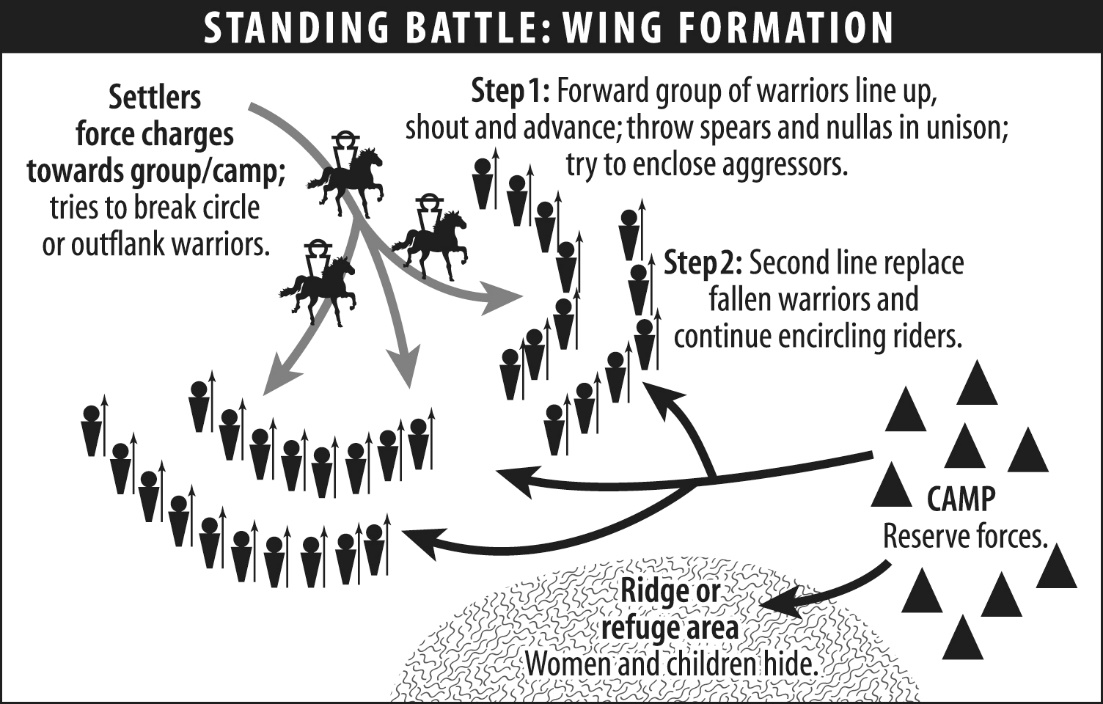
Both in traditional European and Aboriginal society, a pitched (open) battle involving large numbers of people and many rules and protocols was the norm. However, First Nations people quickly discovered this was never a ‘fair fight’ if firearms or horses (cavalry) were involved. Therefore, they only resorted to pitched battles in initial confrontations, or if the odds seemed likely to be in their favour due to their numbers or the terrain.
Indigenous pitched battle with settlers saw rows of warriors hurl numerous projectiles (spears, throwing clubs etc) in simultaneous volleys. In many cases, they employed ‘stockyarding’ – a tactic whereby ‘wings’ of warriors encircled, corralled and engulfed the settler combatants.
Property damage and impeding communication/ transportation
Both settlers and First Nations people frequently engaged in extensive theft and destruction of each other’s property - especially game, weaponry, food stores and homes. This served to intimidate or disable their enemy.
Native Mounted Police disrupted smoke-signalling networks and apprehended messengers (runners) to break efforts at resistance. Pathways were frequently usurped.
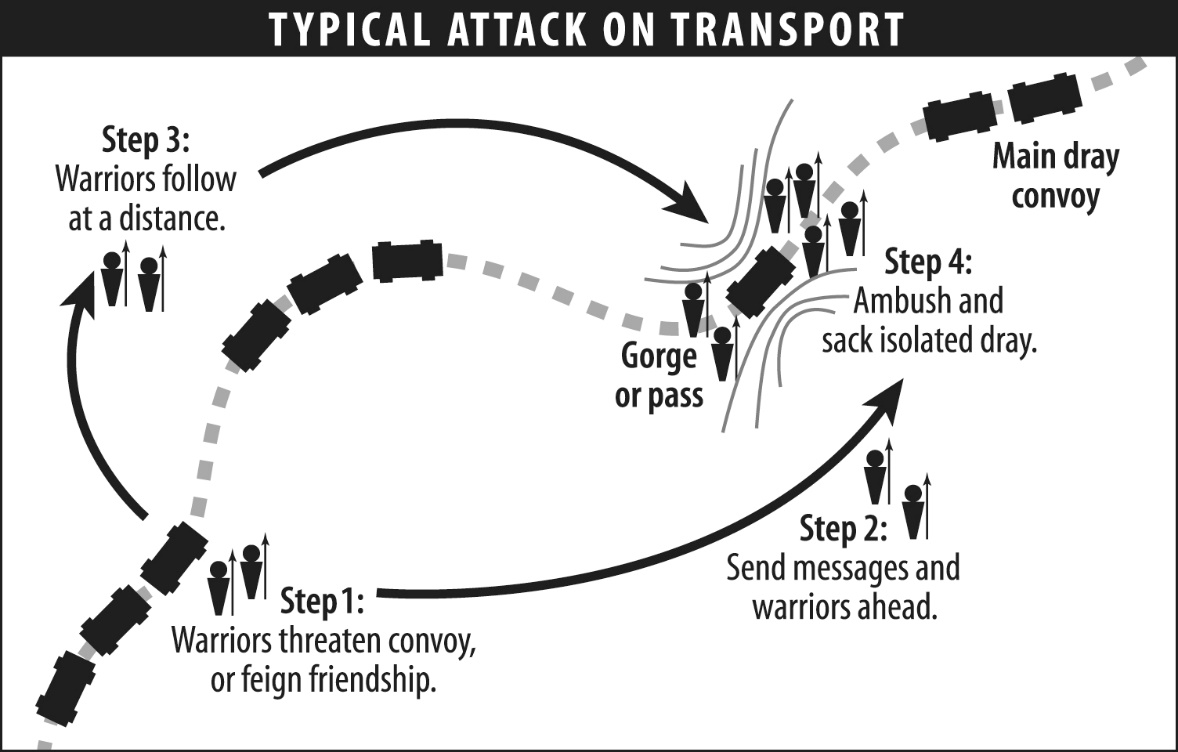
Likewise, First Nations people are recorded blocking roads with logs, killing mailmen, dispersing or killing horses, removing riding gear, destroying beacons, frightening or attacking all settler travellers off their traditional pathways, or constantly attacking ‘road trains’ (convoys of drays). This impeded settler communication/supply chains and helped maintain control of ancient routes and songlines. Along the northern coasts, First Nations people also often hijacked settlers’ boats.
Psychological warfare: harassment, mockery and vandalism
Both settlers and First Nations groups employed this tactic. Settlers created loud sounds, effigies and masks that they attributed to evil spirits, as a means of terrorising First Nations groups, and often they deliberately defaced sacred places or belittled elders and ceremony bosses in front of youths. Others mounted cannons or guns at their homesteads, to scare off Aboriginal parties through frequent ‘warning shots.’ Bluff was a major element of Indigenous warfare. It included magic art to hex invaders, ridicule of settlers, name-calling, threats, ‘warning shots’ (spears thrown very near), and frightening displays of aggression (war dances). It sometimes extended to deliberate uprooting or destruction of graves, fences and property.
TACTICS SPECIFIC TO SETTLERS
Punitive expeditions: dawn raids, camp battles and massacres
Soon after a triggering incident such as Indigenous spearing of shepherds or the killing or removal of cattle or sheep, a message would be sent out riders to homesteads, inns, outstations, telegraph stations, or mining and timber getting camps within a certain radius. Civilian vigilantes - male overseers and staff of these places - would elect to engage in an armed punitive campaign to track down the purported offenders and either take vengeance or apprehend the accused group or their supposed ringleader(s).
In some instances, this activity was organised or led by military or policing officers. Certain punitive expeditions traversed very large areas, employing several parties. Many were unsuccessful in locating or interacting with the accused. Others randomly shot at any First Nations persons they happened to encounter.
For many of these expeditions, settlers rode to a major base camp or inter-tribal gathering, as this would ensure a greater concentration of would be present in one location. Often vigilantes struck at dawn or pre-dawn when there was less likelihood of being detected, surrounding the camp and shooting into it.
At other times, a forward party was sent to apprehend the key suspect(s) whilst other settlers waited nearby. This often erupted into a violent confrontation with other First Nations people coming to the defence of the accused, which resulted in settler ‘back up forces’ entering the affray.
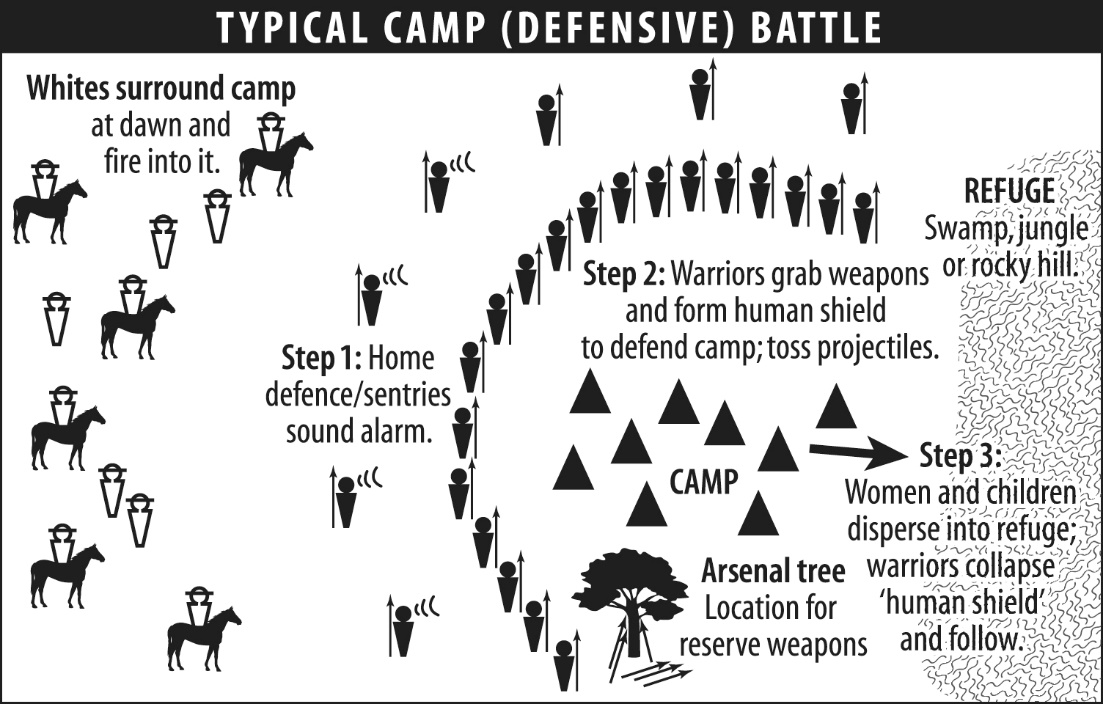
Depending on the agenda of the vigilantes, they would either frighten and drive away the camp residents or slaughter (massacre) as many as possible either in their huts or as they fled. As there was often a spirited resistance (able-bodied warriors forming a wall of defence to enable the rest of the tribe to flee), this often became a ‘camp battle’, with the settler vigilantes destroying as much as they could of the camp’s huts and weaponry, and warriors trying to prevent this or retaliate. Sometimes the vigilantes would be evicted from the camp once the warriors reassembled.
Military and policing patrols: intimidation and dispersals
The Border Police, Native Mounted Police, armed forces and similar bodies often conducted their activities in the same manner as vigilante squads: storming camps through dawn raids. However, as their presence was also meant to intimidate, they frequently engaged in armed demonstrations and lengthy patrols as a ‘show of force.’ Their patrols often saw no engagements but nevertheless served to keep First Nations groups wary and distant.
Native Mounted Police were instructed to ‘disperse’ any large Indigenous gatherings. This consisted in frightening off Aboriginal persons or (more often) wounding and killing large numbers, either when encountered in passing, or wherever they assembled in large bodies.
Stealth poisonings
Baiting flour, bread or water with arsenic and other poisons and leaving these in stores or places where they would be consumed by First Nations people was sometimes employed by civilians as a means of reducing local Indigenous populations. Likewise, diseased blankets were sometimes distributed with this goal.
TACTICS SPECIFIC TO FIRST NATIONS
Vengeance raids: ambush executions and ‘spot killings’
Most Indigenous resistance consisted of ‘payback’ expeditions. These were campaigns that specifically avenged the breaking of tribal law and especially the death of one of your people.
The payback squad would be ritually prepared and would doggedly track the accused often far from home. They could wait months or even decades to strike, counting strongly on the element of surprise to deliver a definitive ambush ‘execution.’
Such expeditions were conducted continuously and over very broad areas, which added an element of terror as they occurred anywhere and often completely unexpected. Most Indigenous actions consisted of such surprise ‘spot killings’, resulting in 1-3 deaths per attack. These could become so numerous that over months and years, hundreds of people were slain.
Economic sabotage and usurping rural industries
Economic sabotage (‘white war’) was the second most common means of resistance. First Nations people called it “starving out.” It entailed dispersing, maiming/ damaging, raiding or destroying the economic base of the settlers: sheep, cattle, horses, pigs, seal pelts, food crops etc. It sometimes extended to destroying stockpiles and food stores; sacking convoys of fleece-filled drays (wagons); and destroying (burning) the pastures on which livestock relied. Such destruction was sometimes conducted on a vast scale across many properties simultaneously.
This was a highly successful tactic, used all over Australia. It often resulted in settlers abandoning or selling their holdings for months to years, due to being economically unsustainable.
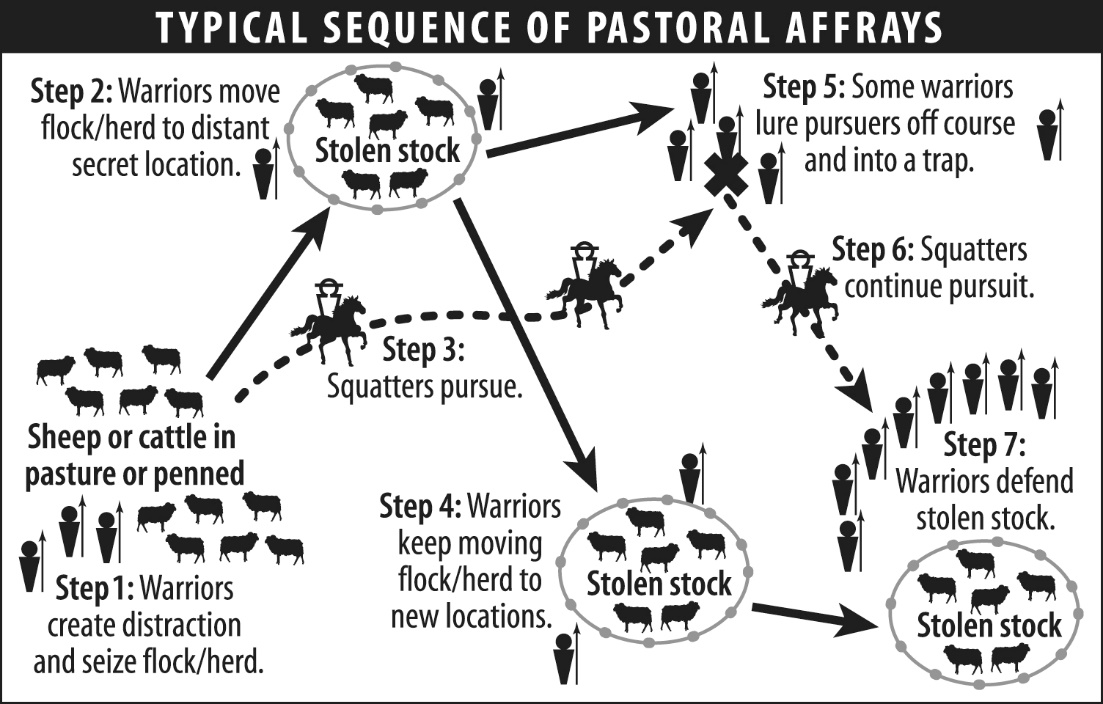
A variation of this practice was ‘usurping pastoralism’ - the theft of large quantities of flocks, herds and horses and placing them under Indigenous management. Livestock were driven tens to hundreds of kilometres away from pastoral holdings. Once here, Indigenous pastoralists would move them around various grazing areas, killing some when needed, much like settler pastoralists.
These First Nations livestock-minders used natural enclosures (e.g. between a campsite and cliffs, bodies of water, or gorges) or otherwise made ‘bush pens’ of brush or rock whenever they needed to box up the livestock.
Many frontier war incidents consisted of the arduous quest of settlers hunting for stolen flocks and herds. Warrior squads would deliberately lead these searchers astray or into traps. When settlers finally located the hidden livestock, there were violent affrays as both sides tried to assert their ownership.
Continual harassment
A defining style of Indigenous warfare was a campaign of constant interference: daily thefts, spearing, displays of aggression, vandalism etc carried out with great frequency, regularity and persistence sometimes day and night for months and years. Although these acts were in themselves minor, in combination, they ‘wore out’ settler incursions and forced withdrawal from newly settled areas.
Sieges and confinement
A commonly recorded tactic was the siege of a homestead, outstation or (sometimes) a small hamlet. This entailed some spies or decoys being sent out for surveillance to discern an opportune moment and keeping a party of warriors in hiding ready to surround the hut/ homestead/hamlet. These pounce into action to make it impossible for the occupants to leave the site.
The purpose of this action was varied. In some cases, warriors sought to contain and extinguish the occupants and their dwellings. In other cases, the aim was harassment to the point that the occupants ran out of ammunition and food and fled the buildings, which were then destroyed. In still other cases, it was a delaying tactic, enabling other groups of combatants to raid stores or shift a flock or herd to a distant location whilst the settlers were confined.
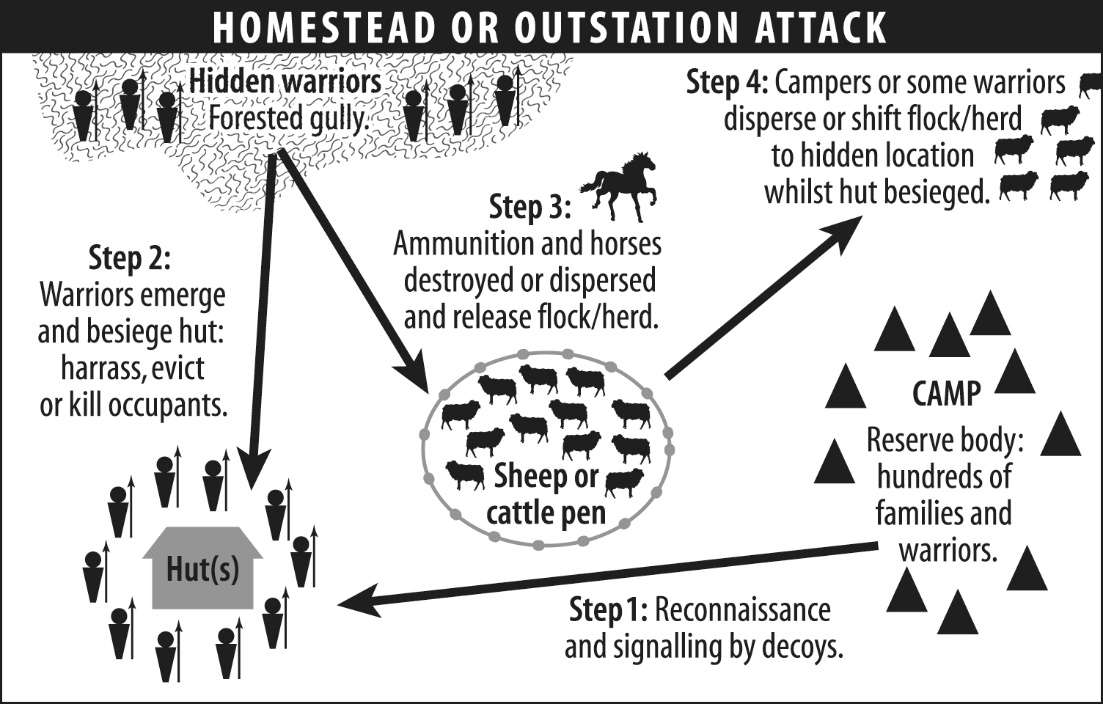
Withdrawal and noncompliance
This was largely passive resistance: ‘walkouts’ where First Nations people would simply remove themselves from missions and homesteads, would refuse to assist or engage with settlers or would withdraw to refuge areas. Apart from the psychological effect of widespread animosity and distrust, this tactic crippled many isolated settlers and economically ruined some stations, as many places relied on Indigenous labour and Indigenous know-how and guides.
Sources
- Berndt, Ronald M., Catherine H. Berndt and John E. Stanton, 1993, A World That Was: The Yaraldi of the Murray River and the Lakes, South Australia, Melbourne: Miegunyah/Melbourne University Press.
- Berndt, Ronald M. and Catherine H. Berndt, 1992, The World of the First Australians: Past and Present, 5th edition Canberra: Aboriginal Studies Press.
- Blandowski, William, 2010 [1860], Harry Allen, ed., Australia: William Blandowski’s Illustrated Encyclopaedia of Aboriginal Australia, Canberra: Aboriginal Studies Press.
- Duncan-Kemp, Alice M., 1968, Where Strange Gods Call, Brisbane: W R Smith & Patterson.
- Gray, W.J.B., 1902, ‘The early days – pioneers and pioneering on the Darling Downs’, Collection of Mrs J. Pollard.
- Kennedy, Edward B., 1904, The Black Police of Queensland: Reminiscences of Official Work and Personal Adventures in the Early Days of the Colony, London: J. Murray.
- Lumholtz, Carl, 1890, ‘A strange tournament’, Southern Argus (Port Elliot), 17 July 1890, p.6.
- MacKenzie, Willie (Gaiarbau), 1982, ‘Some original views around Kilcoy: The Aboriginal perspective’, Gerry Langevad, ed., Queensland Ethnohistory Transcripts, Vol.1:1, St. Lucia: University of Queensland (Archaeology Branch).
- MacKnight, David, 2005, Of Marriage, Violence and Sorcery: The Quest for Power in Northern Queensland, Aldershot: Ashgate Publishing.
- Petrie, C. C., 1904, Tom Petrie’s Reminiscences of Early Queensland (Brisbane: Watson & Ferguson.
- Roth, W. E., 1910, North Queensland Ethnography, Bulletin No. 8, Sydney: Australian Museum.
- Venbrux, Eric, 1995, A Death in the Tiwi Islands: Conflict, Ritual and Social Life in an Australian Aboriginal Community, New York: Cambridge University Press.
- Warner, William Lloyd, 1964, A Black Civilization: A Social Study of an Australian Tribe, Chicago: Harper & Row.
Contributor: Ray Kerkhove, 2025
Recommended Reading
- Callwell, C. E. (1906). Small wars: Their principles and practice (3rd ed.). His Majesty’s Stationery Office. https://www.history.navy.mil/research/library/online-reading-room/title-list-alphabetically/s/small-wars-their-principles-and-practice.html
- Kerkhove, R. (2023). How they fought: Indigenous tactics and weaponry of Australia’s frontier wars. Boolarong Press.
Points to Consider
- Did Aboriginal and Torres Strait Islander people use guns in the Australian Wars and resistance?
- Why / why not?
- How could they obtain guns?
- What advantages or disadvantages did guns, or spears, shields and nullas have?
- How did weaponry on each side change over time?
Summary
Contributor: Ray Kerkhove
Historian and author
(adapted from How They Fought)
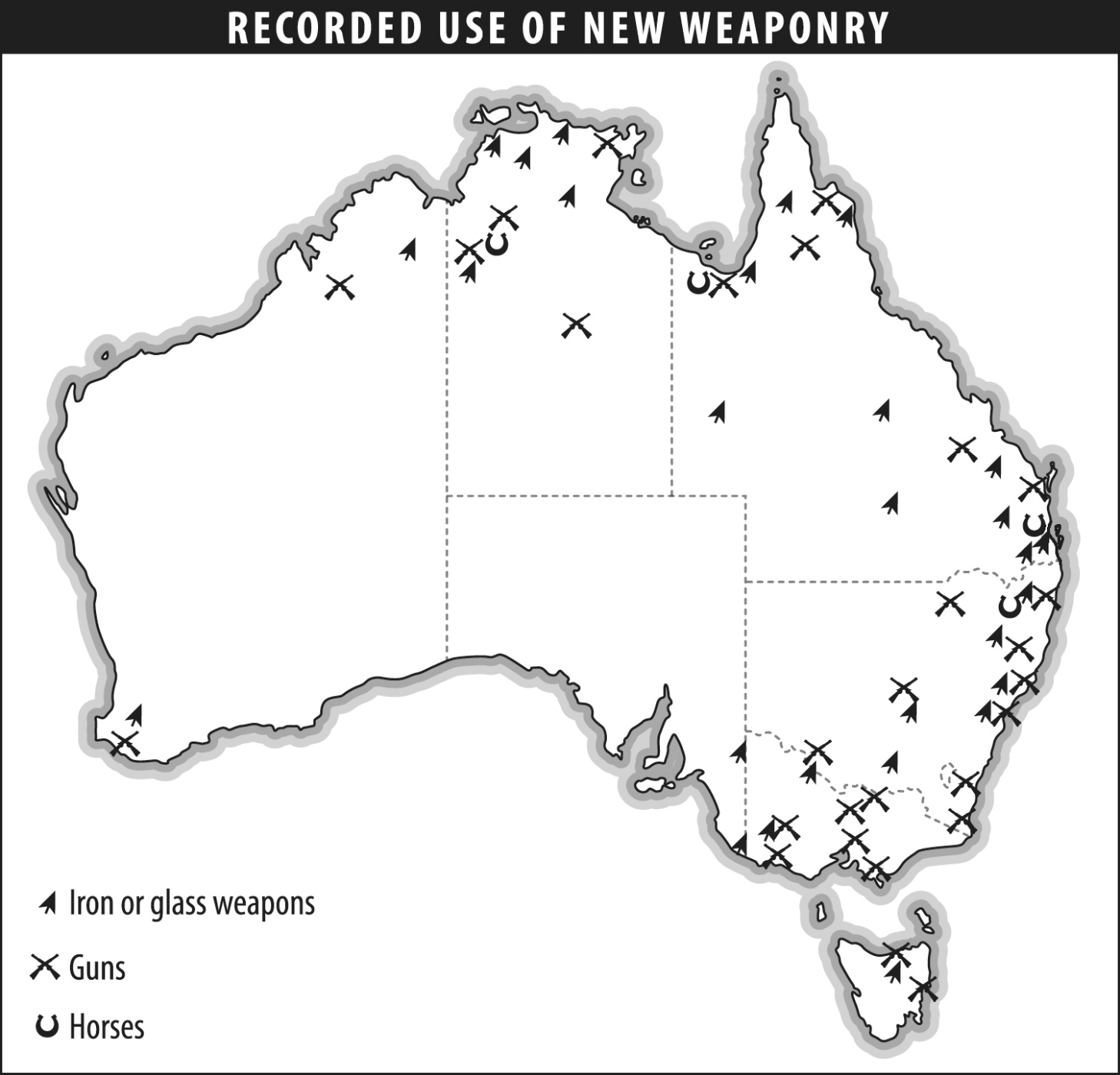
Firearms were initially not a great advantage for Europeans during the Frontier Wars. Most Australian spears had an equal or superior range to the firing of a European musket. Aboriginal warriors were able to toss these and other projectiles (clubs, tomahawks and fighting boomerangs) with great accuracy, silence and unpredictable trajectories. Also, Aboriginal warriors came equipped with dozens of spears each, tossing them in volleys whilst musket-users were busy reloading their weapons. These disadvantages of muskets are shown in the relatively mild tallies of early First Nations/ European skirmishes.
However, once European firearms advanced with repeating rifles in the 1860s, it became possible for even a few well-armed settlers to inflict devastating tolls, despite being vastly outnumbered. For this reason, most Aboriginal fighters became reluctant to meet settlers in open battle and relied increasingly on stealth and surprise one-off assassinations.
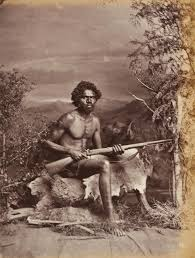
Several factors limited First Nations access to guns. Firstly, legal measures restricted firearms being traded en masse to Aboriginal people. Secondly, settlement expanded so rapidly in Australia that it often overtook the time required to master the new technology or acquire sufficient arsenals (most Australia being seized in 50 years – 1830-1880 - versus the 300 years invasion of North America). Finally, the only source for firearms for Aboriginal warriors was a hostile one: British settlers. This contrasts with North America, where various enemies of American settlers (French, English and Mexican traders) were eager to sell large quantities of guns to First Nations groups. By contrast, Aboriginal fighters mostly had to steal whatever guns they required.
Despite all these disadvantages, accounts of guns being used against settlers occur in most parts of Australia. Beginning in the 1810s and through to the 1940s, firearms were often stolen and used in raids or in attacks on cattle. In the Northern Rivers and New England districts of NSW and in the Kimberley region of WA, many First Nations attacks involved guns. For NSW, this was especially so between the 1840s and 1860s. One report from this area in 1860 complained that ‘the natives are now all armed with firearms and attack in ambush.’ In northern Queensland and the Kimberlys, some warrior-leaders even stole bullet moulds and cast their own bullets.
If First Nations peoples could not obtain firearms, or were unfamiliar with how to use them, they would instead resort to destroying or evading firearms. They developed many tactics for doing this: plugging up portholes; bending and breaking gun muzzles; dampening gunpowder; and removing all musket balls. Sometimes entire arsenals were destroyed. Warriors became adept at always staying just out of the range of fire; attacking between musket reloadings; luring settlers into exhausting their ammunition or otherwise jumping between trees and boulders to shield themselves as they advanced.
Iron provided another settler advantage. Steel swords, sabres, cutlasses, knives and bayonets were at times used against First Nations peoples. For instance, in 1827, police attacked Tasmanian groups using bayonets.

Although First Nations peoples did not know iron technology until the arrival of Macassar traders and Europeans in the last few centuries, they made concerted efforts to procure large quantities as soon as they realised its efficiency. Even the smallest European outposts and camps had iron objects constantly removed by Aboriginal peoples. Iron was also salvaged from dumps, drays and shipwrecks.
In what has been called ‘Australia’s Iron Age’, iron tools and fragments were rapidly traded across the continent. They were beaten and shaped into a range of new weapons. These included nail-headed clubs, sheep shear-headed spears, pronged wire and spike-headed spears, and tomahawks fashioned from horseshoe fragments. One of the most distinctive new weapons across northern Australia was the ‘shovel-nosed spear’ – a very deadly spear fashioned from the inner section of European shovels.
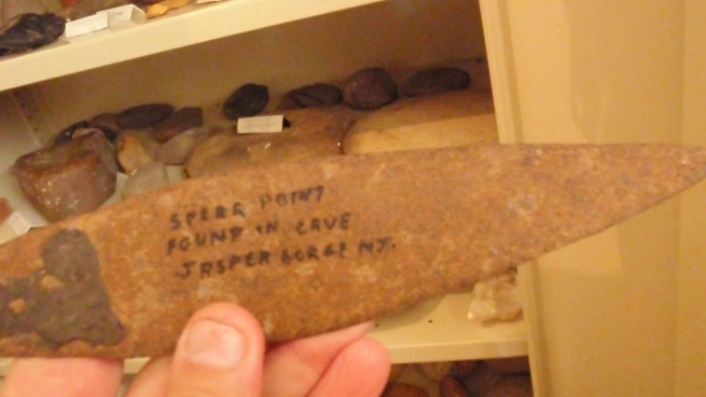
Iron weapons were stockpiled for use against settlers, and to more effectively kill or wound horses and stock. The decimation of stock was partly an adaptation to decreasing local game but was also at times conducted to deplete the economic base on which settlers survived.
Further Reading
- Anon., ‘Aboriginal curios – Victoria River’, Evening Journal (Adelaide), 14 November 1895, p. 2. Trove
- Anon., ‘The Battle of Rolling Bay’, Daily Telegraph (Sydney), 14 March 1910, p. 6. Trove
- Anon., ‘Inquiry into the circumstances attending the deaths of a number of natives on the Murray’, South Australian Register, 25 September 1841, p. 3. Trove
- Anon., ‘Murders by blacks’, Capricornian (Rockhampton), 26 November 1892, p. 37. Trove
- Anon., ‘Outrage by blacks’, Dubbo Dispatch and Wellington Independent, 14 June 1895, p. 4. Trove
- Allen, Harry, 2011, ‘Thomson’s spears: Innovation and change in eastern Arnhem Land projectile technology’, in Yasmine Musharbash and Marcus Barber, eds., Ethnography & the Production of Anthropological Knowledge: Essays in Honour of Nicolas Peterson, Canberra: ANU Press, p. 76.
- Clayton-Dixon, Callum, 2019, Surviving New England – A History of Aboriginal Resistance and Resilience through the First Forty Years of the Colonial Apocalypse, Armidale: Anaiwan Language Revival Program.
- Harrison, Rodney, 2020, ‘Australia’s Iron Age: Aboriginal post-Contact metal artefacts from Old Lamboo Station, Southeast Kimberley, Western Australia’, Australasian Historical Archaeology, Vol. 20, pp. 67–76.
- Jones, Philip, 2007, Ochre and Rust: Artefacts and Encounters on Australian Frontiers, Kent Town: Wakefield Press, pp. 91, 115, 119, 122-128.
- Kennedy, Edward B., 1904, The Black Police of Queensland: Reminiscences of Official Work and Personal Adventures in the Early Days of the Colony, London: J. Murray, pp. 153-154, 161.
- Kerkhove, Ray, 2023, How They Fought, Tingalpa: Boolarong, pp. 243-250, 253-261.
- Lewis, Darrell, 2012, A Wild History: Life and Death on the Victoria River Frontier, Clayton: Monash University Publishing, p. 110.
- Nettelbeck, Amanda, 2004, ‘Writing and remembering frontier conflict: The rule of law in 1880s central Australia’, Aboriginal History, Vol. 28, pp. 190-206.
- Organ, Michael K., 1993, Illawarra and South Coast Aborigines, 1770-1900, Report to the Australian Institute of Aboriginal and Torres Strait Islander Affairs, Canberra: Australian Institute of Aboriginal and Torres Strait Islander Affairs, pp. 76-77.
- Wallis, Lynley, 2020, ‘Wired: Aboriginal people and colonial communication networks’, 27 October, Archaeology of the Frontier, https://archaeologyonthefrontier.com/2019/10/27/wired/, accessed 10 May 2021.
- Wesley, Daryl, 2013, ‘Firearms in rock art of Arnhem Land, Northern Territory, Australia’, Rock Art Research, Australian Rock Art Research Association, Melbourne, Vol. 30:2, November, pp. 235-247.
Points to consider
- Did Aboriginal and Torres Strait Islander people use horses in Australian Wars and resistance?
- Why / why not?
- How could they obtain horses?
- What advantages did horses provide?
- What strategies or tactics were used against horses?
Summary
Contributor: Ray Kerkhove
Historian and author
(adapted from How They Fought)
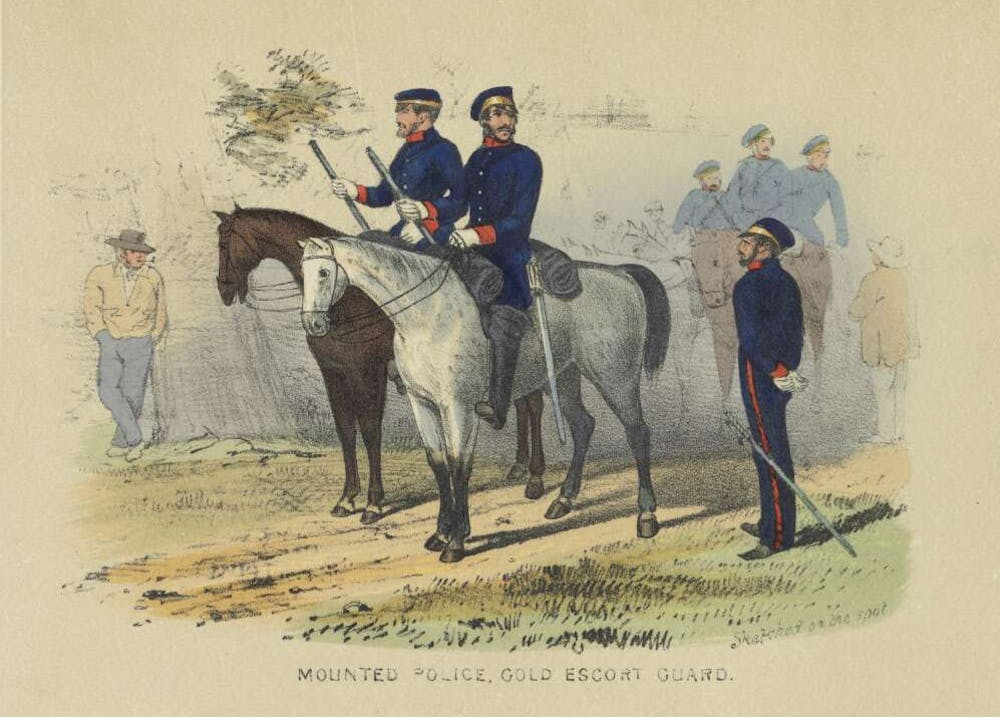
Horses posed a devastating challenge to the protocols of First Nations warfare, as all fighting was traditionally conducted on foot. Horses could over run warriors before they could defend themselves. Simply by being mounted on a horse, a European attacker commanded an elevated vantage point, especially useful in flat, rugged or scrubby terrain. Using horses, Europeans could swiftly reach and overtake armed warriors, chaotically disrupt camps, and speedily retreat. This advantage of speed and distance was one of the main ways Europeans could overcome the First Nations advantages of knowledge of country, stealth and evasion. Even a tiny group of horse riders could cause a great deal of damage. This advantage was ruthlessly exploited by squatters and Native Mounted Police. Almost all their operations were conducted on horseback.
Unlike North America, where wild horses had existed for three centuries and became a staple feature of Plains Indian warfare, Australian brumbies did not form herds till after the 1830s or 1840s, initially not expanding far beyond settled areas. This, and settler prohibitions against Aboriginal people owning (or even riding) horses, meant that First Nations use of horses during the Frontier Wars occurred rather late and sporadic. Even so, there were cases, particularly in northern Australia (for instance Jasper Creek NT and the Gulf of Carpentaria), where stolen horses were used either to attack Europeans or to steal their herds. Indeed, most use of horses by First Nations riders during the Frontier Wars was to steal and move European herds and flocks rather than to directly attack settlers.
When First Nations people did ride, either as native police or working as stockmen after the most intense conflict, they were recognised as exceptionally skillful riders. There was also the phenomenon of what have been called ‘Aboriginal desperadoes.’ These were Aboriginal men and women who operated as bushrangers with just a few associates, mostly in the 1860s-1920s. Although they were more concerned with robberies and other types of assault, their actions often included a rampage of vengeance against specific settlers. Some examples are Jimmy Governor (1875-1901), Yellow Billy (Hunter district), Black Harry (NSW) and Johnny Campbell (Kaiagaru, in southern Queensland).
The more usual manner First Nations groups dealt with horses was to ‘rush’ them. This meant stealthily untying or releasing them and driving them off. As Europeans heavily relied on horses for transport and tactical advantage, ‘rushes’ were very effective in bringing punitive expeditions to a halt. Sometimes the now-horseless party could then be gradually ‘picked off’ or harassed by hidden warriors as it scattered over the countryside, trying to locate the horses.
Many ‘rushes’ were conducted under the cover of darkness. This enabled horses to be driven a great distance away. It also forced the owners to either pursue their attackers on foot or abandon their mission altogether.
In other cases, First Nations warriors favoured the maiming and killing of horses. In a single raid against a prospecting party on the Roper River, eight horses were killed. Both in western Victoria and across the Northern Territory, horse-killing occurred regularly as a part of Aboriginal resistance. The greatest recorded slaughter occurred around south-western Queensland and north-western NSW, where sometimes all the horses on the stations were killed.
First Nations warriors knew how much Europeans valued and needed their horses. Therefore, they would sometimes use ‘horse killing’ as a taunt. For instance, on the Darling Downs, the tails of horses would be taken as trophies and ‘whisked in the first white man’s face they met.’ As horses were so valuable and crucial to European ways of life in Australia, horse killing and 'rushing', further inflamed antagonism.
As conflict intensified in a region, First Nations people strategically used their knowledge of country, such as rocky ground and wetlands, to deny colonists the advantage of horses. Resistance fighters in the Eumeralla War in western Victoria for example, used Budj Bim as a base and retreat because not only was it rich in food, but the ground was strewn with rocks and boulders making it inaccessible to horses.
Reading List
- Anon., ‘1877-1924: A journalist’s memories’, Brisbane Courier, 23 February 1924, p. 19. Trove
- Anon., ‘The Aboriginal desperadoes’, Armidale Chronicle, 18 August 1900, p. 5 Trove
- Anon., ‘Moreton Bay’, Bathurst Advocate, 3 June 1848, p. 1. Trove
- Anon., ‘Old bushranging days’, Mudgee Guardian and North-western Representative, 13 December 1900, p. 5 Trove
- Anon., ‘Outrage by blacks’, Dubbo Dispatch and Wellington Independent, 14 June 1895, p. 4. Trove
- Charola, Erika and Felicity Meakins, ed, 2016, Yijarni: True Stories from Gurindji Country, Canberra: Aboriginal Studies Press.
- Fijn, Natasha, November 2017, ‘Encountering the horse: Initial reactions of Aboriginal Australians to a domesticated animal’, Australian Humanities Review, Vol. 62, pp. 1-15.
- Kennedy, Alexander, 1924, ‘Northwestern Queensland – some recollections of pioneering days’, Graziers’ Review, 16 February 1924, p. 1292.
- Kerkhove, Ray, 2023, How They Fought, Tingalpa: Boolarong Press, pp. 261-268.
- Lewis, Darrell, 2012, A Wild History: Life and Death on the Victoria River Frontier, Clayton: Monash University Publishing.
- McNiven, I. J., Crouch, J., Richards, T., Dolby, N., Jacobsen, G., & Gunditj Mirring Traditional Owners Aboriginal Corporation. (2017). Kurtonitj stone house: Excavation of a mid-nineteenth century Aboriginal frontier site from Gunditjmara country, south-west Victoria. Archaeology in Oceania, 52(3), 184–197
- Mitchell, Peter, 2015, Horse Nations: The Worldwide Impact of the Horse on Indigenous Societies Post-1492, Oxford: Oxford University Press.
- Nunkiarry, George, 1996, ‘No bell ringing’, in Kimberley Language Resource Centre and Matthew Wrigley, 1996, Moola Bulla – In the Shadow of the Mountain, Broome: Magabala, p. 36.
Points to consider
- If killing was considered a crime would people who kill speak openly about what they or others had done?
- Why or why not? If they sometimes did or didn't, why in some cases and not others?
- If they could not speak openly, or officially, yet it was common knowledge, what words and phrases did people use to describe various kinds of colonial-Indigenous violence?
Euphemisms in Australian Colonial Conflict
Contributors: Dr Robyn Smith, Dr Chris Owen, Dr Jennifer Debenham, Paul Desney
WARNING
This page includes words and descriptions that are derogatory, offensive and/or unacceptable. They are no longer in common use and are included here only for education about colonisation in Australia, and to illustrate attitudes of the time.
Word Use
Readers are advised that word use preferred by Aboriginal and Torres Strait Islander (ATSI) people varies from place to place and person to person.
Subject to the context and whether or not it is a direct quote, the words ‘Aboriginal’, ‘First Nations’ and ‘Indigenous’ are used interchangeably in this document.
Notes
Where Aboriginal words are used in colonial records, they are subject to interpretation, reinterpretation and revision by linguists, anthropologists and a range of others. This gives rise to significant spelling variations of the same word.
Introduction
Frontier violence, abuse and exploitation were often open secrets on the Australian frontier. Colonists nonetheless feared the severity of punishment under British law if they were caught and found guilty, though this seldom happened. For example, of 438 known massacres of six or more people, only one, the Myall Creek massacre, resulted in colonists being found guilty and sentenced to death. They also feared being ostracised by the colonial community.
Here are just a few examples from Northern Australia:
Donald Swan described the Kimberley ‘bushman’s code of honour’ on shootings in punitive expeditions thus: ‘Either stand in with the mob and keep your mouth shut or refuse to stand in and also keep your mouth shut. In either case you will be respected and no more will be required of you in the matter’ (Owen, 2016, p 147).
And:
Writing to his political friend John Lewis in 1878, Northern Territory Police Inspector Paul Foelsche confided: “Of course you have seen all about our nigger hunt in the papers. There has been no end of telegraphing from the Minister about the affair and orders have been sent to the effect that in pursuing Natives for offences committed by them, no firearms are to be used except in extreme cases and in self-defence, but we’ll be able to regulate all that…” (Smith, 2024, p 48).
And:
Another illuminating example was explorer Aeneas Gunn’s observation that: ‘It is considered a breach of northern etiquette to ask a man whether or not he shot a blackfellow or not.’ This is revealing, both in the sense that it was deemed acceptable, but also that it was considered bad manners to talk about it (Owen cited in Smith, 2024, p 118).
The code of silence led to many euphemisms or ‘code words’ for immoral and illegal acts. Some of these and their most commonly understood interpretations are listed here.
| Word | Codified meaning | Example of use | Authorities |
|---|---|---|---|
| Assimilation | Against the backdrop of an official position under the Immigration Restriction Act 1901 commonly known as the ‘White Australia policy’, various Aboriginal ‘protection’ and ‘welfare’ Acts were enacted. It was legislative instruments in different states that authorised child removals, forced ‘British’ education and punishment for engaging in cultural practices (eg language, ceremony, contact with kin, etc). |
Government policies to ‘breed out the colour’ of Aboriginal people over successive generations with a belief that ‘black would go white.’ Herding people off their land and onto the least fertile/arable/productive land in the region, facilitating the Stolen Generations, establishment of missions and ‘welfare’ stations, etc. |
Neville AO (1947) Australia’s Coloured Minority: Its Place in the Community, Currawong Publishing Co, Sydney. The Aborigines Act 1905 (WA) Aborigines Act Amendment Act 1936 (WA) Native Administration Act 1936 And: |
| Band | Aboriginal cultural group otherwise known as ‘mob’, clan or ‘tribe.’ | Tindale N (1974) Aboriginal Tribes of Australia: Their terrain, Environmental Controls, Distribution, Limits and Proper Names, University of California Press. | |
| Black velvet | The ‘colonial fetish’ for black women, typically with sexual connotations (McGrath, 1984, p 237). Not a phrase that is exclusive to Australia. It was used in the USA along with ‘brown sugar’. |
D’Arcy’s in a temper and Armstrong’s in black velvet… (NTTG, 18 June 1881, p 2). Revered author Henry Lawson was one of the first to popularise the phrase ‘black velvet’. It described the soft, smooth skin of Aboriginal women – or ‘gins’, as they were referred to then. The men who associated with Aboriginal women were known as ‘gin jockeys’. And their children were often referred to as ‘burnt corks’ (Phillips, 2016, np). |
‘NT Bulletin’ in Northern Territory Times and Gazette, 18 June 1881. Phillips S ‘Black Velvet: redefining and celebrating Indigenous Australian women in art’ in The Conversation, 9 May 2016: Black Velvet: redefining and celebrating Indigenous Australian women in art McGrath A ‘”Black Velvet”: Aboriginal women and their relations with white men in the Northern Territory, 1910-1940’ in So Much Hard Work: Women and Prostitution in Australian History (1984) Australian National University, Canberra, pp 233-297. |
| Blackboy | Manservant, slave, stockman, policeman, police tracker. Aboriginal adult male. | A blackboy named Boz, who has been employed at the station for six or seven years, is supposed to have killed both the men; it seems certain that he killed one of them. Police and volunteers are out after the murderers but the fearful dry season and the difficulty of tracking in this weather is all in favour of the natives (NTTG, 4 March 1892, p 3). | ‘Murder of two white men by blacks’ in Northern Territory Times and Gazette, 4 March 1892. |
| Caste | The percentage or ‘quantum’ of Aboriginal blood compared with ‘European blood.’ | The child is half-caste from Alroy Downs. There were Registers of Half Castes in addition to which pastoral stations were required to maintain a Register of Births. These were referred to as ‘Stud Books’ and children were often given the surname of the station on which they were born (eg Jack Moolbong, Ronald Alexandria, Jimmy Wavehill). |
‘Thompson’s List of Half Castes in the Northern Territory 1899-1900’ in Government Resident of the Northern Territory Inwards Correspondence 1870-1912, Northern Territory Archives Service, NTRS 790, Item 10441: Thompson’s List of “Half Castes” in the Northern Territory, 1899-1900 Aboriginal Half Caste Population Records, National Archives of Australia (Darwin Office), Series F984: |
| Combo / Komboism / concubine | Aboriginal woman, usually a sexual slave, often dressed as a stockboy to avoid authorities. See also Drover’s Boy. |
In a practice known among the white population as ‘komboism’, Aboriginal women and often girls as young as ten were taken or traded by Aboriginal men and prostituted to pearlers. The Sunday Times alleged in 1905 that girls were exchanged for ‘gin, tobacco, flour and rice’. Women are to be seen on the roads dressed up as men. "Komboism” is rife (Owen, 2016, p 377). |
Owen C (2016) ‘Every Mother’s Son is guilty’: Policing the Kimberley Frontier of Western Australia, UWAP, Nedlands. Roth WE (1905) Royal Commission on the Condition of the Natives, Presented to Both Houses of Parliament by His Excellency’s Command, Perth, Government Printer, 1905, 2nd Session, No 5, p 25. |
| Demonstration of force | Overwhelming show of armed colonial domination for repressive purposes. | The latest news from New Zealand is extremely discouraging. There is, it appears, every probability of another outbreak of hostilities in that colony, unless a sudden change comes over the spirit of the malcontent Maories…Besides, the settlers on the West Coast having complained against the violence of the natives, the Government have dispatched troops of constables thither, and have otherwise begun to make a demonstration of force, in the hope, no doubt, of overawing the malcontents (SA Register, 1 July 1879, p 4). | ‘Native Affairs in New Zealand’ in South Australian Register, 1 July 1879. |
| Dispersal | The word that police and colonists used across Australia for murder thus avoiding implicating themselves in a criminal act. | The 1929 memoirs of August Lucanus, a special constable on the punitive expedition, stated only that ‘[t]here must have been at least 200 blacks, and they had not even tried to obliterate their tracks, we soon overtook them and they put up a fight…We dispersed them at last, and returned to Wyndham (Owen cited in Smith, 2024, p 53). Officials from the [Western Australian] Aborigines Protection Board wrote about ‘dispersals’ in these terms: ‘It is strange that if a tribe in India or Africa is troublesome an expedition is organised and the natives are ‘taught a lesson’. If individuals are troublesome here (for there are no tribes) he is ‘taught a lesson’, it is murder but it is called ‘dispersing the natives’ (Aborigines Protection Board, Correspondence, 21 August 1896, SROWA, Private Item 58, Cons 495 in Owen, 2016, pp 145-146).’ |
Smith R (2024) Licence to Kill: massacre men of Australia’s north, Historical Society of the Northern Territory, Darwin. Owen C (2016) ‘Every Mother’s Son is Guilty’: Policing the Kimberley Frontier of Western Australia 1882-1905, UWAP, Nedlands. |
| Drover’s Boy | Aboriginal woman, a pastoral slave also enslaved for sexual purposes. See ‘Komboism.’ | In the Camooweal pub they talked about And he told of the massacre in the west |
Dowling J (2002) The Drover’s Boy, Art Gallery of Western Australia, Perth: The drover’s boy - Art Gallery WA Egan T (1981) The Drover’s Boy, Ted Egan Enterprises, Alice Springs: |
| Dust-throwing | Deliberate diversion to distract people from what is really going on (such as a planned massacre) | Further consultations being necessary, Dan feared arousing suspicion, and to ensure his surprise party, and to guard against any word of the coming patrol being sent out-bush by the station “boys,” he indulged in a little dust-throwing, and there was much talking in public about going “out to the north-west for the boss to have another look round there,” and much laying of deep plans in private (Gunn, 1907, np). | Gunn Mrs A (1907) We of the Never Never, 15th Edition, MacMillan, New York, Chapter 20: |
| Gin | Aboriginal woman | Revered author Henry Lawson was one of the first to popularise the phrase ‘black velvet’. It described the soft, smooth skin of Aboriginal women – or ‘gins’, as they were referred to then. The men who associated with Aboriginal women were known as ‘gin jockeys’. And their children were often referred to as ‘burnt corks’ (Phillips, 2016, np). | Phillips S ‘Black Velvet: redefining and celebrating Indigenous Australian women in art’ in The Conversation, 9 May 2016: Black Velvet: redefining and celebrating Indigenous Australian women in art Connor L ‘The “Lubra” Type in Australian Imaginings of the Aboriginal Woman from 1836-1973’ in Gender and History, Vol 25, No 2, August 2013, pp 230-251. |
| Gin jockey | White man either cohabiting with an Aboriginal woman or a rapist of Aboriginal women. Either way, usually socially derided because of her colour rather than his violence (where applicable). Also known as ‘gin rooter’. Sometimes worn as a masculine colonial badge of honour. | Before he died in November 1984, aged 83, Xavier Herbert gave an interview in central Australia in which, during 3½ hours, he talked of the widespread practice in Australia's north and north-west of what he called "gin rooting", as well as boasting of having been, as a young man in the 1920s, "the biggest gin rooter around" (Ramsey, SMH, 2 Feb 2008, np). | Ramsey A ‘Weasel words won’t hide monstrous shame’ in Sydney Morning Herald, 2 February 2008: |
| Girl | Aboriginal woman, domestic servant, nanny. Usually but not exclusively an adult Aboriginal woman. | See ‘Combo’ above. | |
| Give a dose | Poison | Patrick Byrne, a dray driver, was an eye-witness to events at Thomas Coutts’ Kangaroo Creek Station. Inter alia, he wrote: ‘I had heard it murmured on the Farm that "the Blacks were going to have a dose"— By a dose I mean that the Blacks were to be poisoned—John Ryan told me of it…’ (see Lydon, 1996 at p 156). | Lydon J ‘“No moral doubt…”: Aboriginal evidence and the Kangaroo Creek poisoning, 1847-1849’ in Aboriginal History, 1996, Vol 20, pp 151-175. |
| Give a lesson | Overwhelming attack by colonists on Aboriginal people designed to kill and/or pacify the accused. | We think, therefore, that the late sad occurrence shows the necessity of at once repressing the murderous proclivities of the natives with a firm hand, and giving them a lesson which they will not be likely to forget (NTTG, 10 June 1882, p 2). | ‘The late Outrage by Blacks’ in Northern Territory Times and Gazette, 10 June 1882. |
| Half caste | An Aboriginal person considered to have ‘half’ Aboriginal blood and half ‘white’ blood.’ See also Quadroon and Octaroon. |
‘Every Aboriginal Native of Australia, and every Aboriginal half-caste or child of a half-caste, such half-caste or child habitually associating and living with Aboriginals, shall be deemed to be an Aboriginal within the meaning of this Act, and at the hearing of any case the Justice or Justices adjudicating may, in the absence of other sufficient evidence, decide on his or their own view and judgment whether any person with reference to whom any proceedings shall have been taken under this Act is or is not an Aboriginal.’ Aborigines Protection Act 1886 (WA). | Aborigines Protection Act 1886 (Vic) Aborigines Protection Act 1886 (WA) See also: Half-caste, Coloured and Mission Records And: |
| Lubra | Aboriginal woman, ‘…a primary term in the lexicon of Australian racism.’ Thought to have derived from the Palawa ‘lubara’ or ‘leuberer’, meaning ‘wife’, first appearing in print in 1829 (see Connor, p 233). | …Sam Lee was full of surprises, and the lubras’ methods of house-cleaning were novel in the extreme (Gunn, 1907, np). | Connor L ‘The “Lubra” Type in Australian Imaginings of the Aboriginal Woman from 1836-1973’ in Gender and History, Vol 25, No 2, August 2013, pp 230-251. Gunn Mrs A (1907) We of the Never Never, 15th Edition, MacMillan, New York, Chapter 7: |
| Making people quiet | Pacifying Aboriginal resistance. See also ‘quiet and useful’ below. | “Making people quiet” is the vivid phrase that some present-day Elsey Aborigines use to describe the treatment of their ancestors in the early days of pastoral settlement, when Northern Territory Aborigines were generally regarded as a ‘problem’’, a menace to stock and stockmen alike (Merlan, 1978, p 71). | Merlan F “‘Making People Quiet” in the Pastoral North: Reminiscences of Elsey Station’ in Aboriginal History, Vol 2, No 1, 1978, pp 71-106. |
| Miscegenation | White male colonists having relationships with Aboriginal women. Illegal under legislation and during certain time periods. See ‘Caste’ and ‘Komboism’. | ‘Thompson’s List of Half Castes in the Northern Territory 1899-1900’ in Government Resident of the Northern Territory Inwards Correspondence 1870-1912, Northern Territory Archives Service, NTRS 790, Item 10441: Thompson’s List of “Half Castes” in the Northern Territory, 1899-1900 Aboriginal Half Caste Population Records, National Archives of Australia (Darwin Office), Series F984: Aboriginal Half Caste Population Records (NAA) Owen C (2016) ‘Every Mother’s Son is guilty’: Policing the Kimberley Frontier of Western Australia, UWAP, Nedlands. Roth WE (1905) Royal Commission on the Condition of the Natives, Presented to Both Houses of Parliament by His Excellency’s Command, Perth, Government Printer, 1905, 2nd Session, No 5, p 25. |
|
| Mission | Institutions that were generally established by religious orders with limited funding from the government to ‘train’ Aboriginal people in ‘civilisation’. | A week or so ago we published a report brought in by the Rev. Jas Watson, of the Goulburn Island Aboriginal Mission, re the prevalence of what appeared to be a very bad type of fever among the natives…Dr. Jones describes the disease as a malignant type of terrain malaria, similar to that prevalent in New Guinea… (NTTG, 28 June 1917, p 13). | ‘Sickness Among Aboriginals’ in Northern Territory Times and Gazette, 28 June 1917. See also Australian Institute of Aboriginal and Torres Strait Islander Studies: https://aiatsis.gov.au/explore/missions-stations-and-reserves |
| Myall | Derogatory name for an Aboriginal person (generally an East coast or NT reference). | One of these niggers is an old Queensland trooper, and consequently more dangerous than a hundred “myalls.” Both are well armed, having been provided with revolvers and ammunition to protect themselves against the natives when horse and bullock hunting. Knowing themselves already amenable to the law, there is no knowing where the depredations of these fellows may stop, and it is to be hoped that they will soon be arrested (NTTG, 7 July 1883, p 2). | ‘Carriers Robbed by Blacks’ in Northern Territory Times and Gazette, 7 July 1883. |
| Native Assistant | An armed (despite it being illegal) Aboriginal Police assistant in WA. Largely identical with the Queensland Native Police, they were usually taken from prison or removed from their own country because local affiliations impeded their intended function. | Native assistants were Aboriginal men who often were recruited for their skills in bush craft, tracking, knowledge of country, tending to horses and use of firearms. Regardless of their age they were infantilised and known as ‘the boys’. Critically they acted as interpreters for the police, often gaining information from those arrested about movements of different Aboriginal groups (Owen, 2016, p 167). | Owen C (2016) ‘Every Mother’s Son is Guilty’: Policing the Kimberley Frontier of Western Australia 1882-1905, UWAP, Nedlands. |
| Nigger hunt | A rolling or serial massacre, often over a great distance and a long period of time. The biggest were when a white colonist was killed. | ‘MR. P. FOELSCHE, Inspector of Police, proceeded to the Daly River early this week to "general" the nigger hunt now going on there’ (North Australian, 26 September 1884, p 2). ‘One lesson they learnt from this chase, [punitive expedition] however, was that ‘treachery on the part of the blacks must be met with ‘strategy’ by the white. The straight out ‘nigger hunt’ would get them nowhere…’ (Durack, 1959, p 286). |
‘Things and Others’ in North Australian, 26 September 1884. Gunn Mrs A (1907) We of the Never Never, 15th Edition, MacMillan, New York, Chapters 19-20: Durack M (1959) Kings in Grass Castles, Constable and Company, London. |
| Niggers in | Cattle killing | On stations in the Never-Never the blacks are supposed to camp either in the homesteads, where no man need go hungry, or right outside the boundaries on waters beyond the cattle, travelling in or out as desired, on condition that they keep to the main travellers’ tracks—blacks among the cattle having a scattering effect on the herd, apart from the fact that “niggers in” generally means cattle-killing (Gunn, 1907, np). | Gunn Mrs A (1907) We of the Never Never, 15th Edition, MacMillan, New York, Chapter 20: |
| Octoroon | An Aboriginal person considered to have one eighth Aboriginal blood. | Quadroons and octoroons—As already indicated, the crossbreed with a preponderance of white blood should be considered separately. Their blood entitles them to be given a chance to take their place in the white community and on as favorable a footing as possible. That this may be successfully accomplished, the children should be removed from aboriginal associations at the earliest possible age and given all the advantages in education and vocational training possible to the white State children, to minimize as far as possible the handicap of their colour and friendless circumstances (Bleakley, 1928, p 29). Note: Bleakley was the Chief Protector of Aboriginals in Queensland. |
Bleakley JW (1928) Report: The Aboriginals and Half-Castes of Central Australia and North Australia, Parliament of Australia, 8 February 1929: The aboriginals and half-castes of Central Australia and North Australia : report Half-Caste, Coloured and Mission Records, National Archives of Australia: Half-caste, Coloured and Mission Records Roth WE (1905) Royal Commission on the Condition of the Natives, Presented to Both Houses of Parliament by His Excellency’s Command, Perth, Government Printer, 1905, 2nd Session, No 5, p 25. ‘Thompson’s List of Half Castes in the Northern Territory 1899-1900’ in Government Resident of the Northern Territory Inwards Correspondence 1870-1912, Northern Territory Archives Service, NTRS 790, Item 10441: Thompson’s List of “Half Castes” in the Northern Territory, 1899-1900 Aboriginal Half Caste Population Records, National Archives of Australia (Darwin Office), Series F984: |
| Outrage | An alleged or perceived crime by Aboriginal people against colonists. | In another column we publish the particulars, as far as we have been able to glean them, of a bloody massacre of Chinese teamsters, perpetrated last Sunday by a party of blacks near the Banyan (NTTG, 10 June 1882, p 2). | ‘The late Outrage by Blacks’ in Northern Territory Times and Gazette, 10 June 1882. |
| Picnic with the natives | Serial slaughter, massacre. | ‘When he heard of the incident, the head of the Territory’s small police force, Inspector Paul Foelsche, wrote to a friend, saying that he had arranged for a police party to go to the Roper River to bring back the body and to ‘have a Picnic with the Natives.’ The parties of police and civilians operating separately along the Roper over the next six weeks several times attacked Aborigines suspected of having been involved’ (Reid, 1990, p xi). | Reid G (1990) A picnic with the natives: Aboriginal-European relations in the Northern Territory to 1910, Melbourne University Press, Melbourne. |
| Pioneer | Colonial term for the first to take up Aboriginal land. | Enough bush to bury a man in! That’s all these men of the droving days have ever asked of their nation and yet without them the pioneers would have been tied hand and foot, and because of them Australia is what it is (Gunn, 1907, np). | Gunn Mrs A (1907) We of the Never Never, 15th Edition, MacMillan, New York, Chapter 4: |
| Protector | Colonists, including police and medical practitioners, who had powers under government legislation over Aboriginal people. | Other cogs over the course of history were overland telegraph officers, welfare officers, “protectors” (some of whom were police), doctors (some of whom were protectors) and magistrates. In fact, many Aboriginal people in the NT are rightfully distrustful of almost any organ of government (Smith, 2024, np). | Reid B (2022) Protection at a Price: Protection of the Aborigines in the Commonwealth's Northern Territory, 1911-1978, Historical Society of the Northern Territory, Darwin. Reid B (2020) Power and Protection: the contest between the Government Residents and the medical Protectors of the Aborigines in South Australia’s Northern Territory, Historical Society of the Northern Territory, Darwin. Smith R ‘NT election: promises for Indigenous people buckle under history’s weight’ in The Conversation, 22 August 2024: And see: Aborigines Protection Act 1886 (Vic) Aborigines Protection Act 1886 (WA) |
| Punitive expedition | Massacre of Aboriginal people. Generally there was a sliding scale of alleged offences: (1) being accused of cattle/stock killing was the lowest although no less lethal; (2) being accused of killing a colonist’s (highly valued) horse or other assets; (3) being accused of the murder of a white colonist. In cases of the latter, the entire colonial community might participate in revenge killings over several weeks or months. | Constable Collins was speared right through the body. He lived through the night, but died next morning. Twenty-three natives were shot during the fight and several were arrested. A punitive expedition of police will probably be arranged to follow the natives (Express & Telegraph, 29 September 1893, p 2). | ‘The Spearing of Constable Collins’ in Express and Telegraph (SA), 29 September 1893. |
| Quadroon | An Aboriginal person considered to have one-quarter Aboriginal blood. See Assimilation and various Registers. | Quadroons and octoroons—As already indicated, the crossbreed with a preponderance of white blood should be considered separately. Their blood entitles them to be given a chance to take their place in the white community and on as favorable a footing as possible. That this may be successfully accomplished, the children should be removed from aboriginal associations at the earliest possible age and given all the advantages in education and vocational training possible to the white State children, to minimize as far as possible the handicap of their colour and friendless circumstances (Bleakley, 1928, p 29). Note: Bleakley was the Chief Protector of Aboriginals in Queensland. |
Bleakley JW (1928) Report: The Aboriginals and Half-Castes of Central Australia and North Australia, Parliament of Australia, 8 February 1929: The aboriginals and half-castes of Central Australia and North Australia : report And see: |
| Quiet and useful | Conversion into economic asset (ie free labour or slavery, particularly on pastoral stations) | The same trouble was experienced at Owen Springs and all the places mentioned on the Finke. We petitioned the South Australian Government to allow the police officer at Alice Springs to organize a body of black trackers to assist the trooper in stopping the cattle killers. This was granted, and six of the best boys from southern stations were placed under MC Wurmbrandt who had them well drilled in a short time. It had a wholesome effect, and cattle killing came to an end. I have known the blacks in those days to spear 13 head of cattle at Simpson's Gap, and never took a steak off any of them. To my knowledge, they were never cruelly treated by the whites. It was the custom to kill cattle frequently for the natives, hoping that this would prevent them from spearing so many on the run. It had no effect, as they seemed determined to drive every settler out of the country, but in the native police — like the old saying, “Set a rogue to catch a rogue” — they found that there was no getting away from these boys, and they soon became quiet and useful (Alec Ross, Manager of Undoolya Station from 1880, in The Register, 26 September 1928, p 6). The need to develop the north was generally accepted by Australians, and the ‘Aboriginal question’ was then phrased in terms of controlling Aborigines, keeping them from the cattle and, if possible, converting them into an economic asset (Merlan, 1978, p 71). |
Ross A ‘Pastoral Pioneering in Central Australia: Blacks as Cattle Killers’ in The Register, 26 September 1928. Merlan F “‘Making People Quiet” in the Pastoral North: Reminiscences of Elsey Station’ in Aboriginal History, Vol 2, No 1, 1978, pp 71-106. |
| Reprisal | Punitive expedition | The Chief Secretary replied denying the truth of the statements contained in the letter and stated that the Government were not concerned in any acts of reprisal against the blacks in connection with the Daly River outrages (NTTG,13 June 1885, p 3). | ‘Latest Telegrams’ in Northern Territory Times and Gazette, 13 June 1885. |
| Retaliation | Killing/murder | As many as possible of these should be secured, and treated according to martial law before the rest of the tribe present, if, having joined the main body of the tribe it is within, the ability of the police trackers to pick them out if not surrendered. If this was faithfully carried out by the leader in strict justice it would strike terror into any tribe, and would lead to no revenge or retaliation on their part because they would know why and wherefore (NTTG, 24 June 1882, p 2). | George H Bright, ‘Letter to the Editor - Black Trackers’ in Northern Territory Times and Gazette, 24 June 1882. |
| Rough justice | A term used by colonists who took the law into their own hands and killed Aboriginal people justified by claims that there was no authority who would assist them. | We have had more than one instance of the influence of that darkness in the verdicts of Northern Territory Juries when the question of justice between black and white arises. It is not so much the degradation of the blacks I am now thinking of as the wholesale degradation of the so-called "whites." When by force we deprive these native people of the lands on which they have lived for unknown ages do we at least owe them protection against the oppression, cruelty, and nameless atrocities and abominations of what are called the "hardy pioneers of civilization." As we signally fail to protect the natives from our Criminal class, the moral law justifies them in executing rough justice on the miscreants who oppress and degrade them (Adelaide Observer, 17 June 1899, p 2). | J de la Z Sutherland ‘Northern Territory Affairs’ in Adelaide Observer, 17 June 1899. See also: Durack M (1959) Kings in Grass Castles, Constable and Company, London (p 286). |
| Savage | Aboriginal or Torres Strait Islander person | The administrative regimes of colonial bureaucracies extended the inscriptions of Islanders as ‘lost souls’ and ‘savages’ and deployed a new ‘commonsense’ that constituted Islanders are ‘overgrown children’, as ‘dependents’ of the state who needed protection from ‘outside influences’ (Nakata, 2007, p 11). | Nakata M (2007) Disciplining the Savages; Savaging the Disciplines, Aboriginal Studies Press, Canberra. |
| Selection | Colonial term for which area of land they took up | But I do say, and I think "Caution" will agree, that times have changed, and that the would-be settler should be encouraged to locate on the land, say in moderate issued farms of three or four hundred acres, by free selection, and deferred payments…(MZ, SA Advertiser, 4 January 1862, p 2). | ‘Land Laws’ in South Australian Advertiser, 4 January 1862. |
| Settlement | Colonisation | Here and there, kangaroos and other wild creatures of the bush hopped out of our way, and sitting up, looked curiously after us; again and again little groups of blacks hailed us, and scrambled after water-melon and tobacco, with shouts of delight, and, invariably, on nearing the tiny settlements along the railway, we drove before us white fleeing flocks of goats is (Gunn, 1907, np). | Gunn Mrs A (1907) We of the Never Never, 15th Edition, MacMillan, New York, Chapter 2: |
| Settler | Coloniser | By the Tambora a large number of our European population left for Sydney, Melbourne, and Adelaide. Thirty-one adults and three children is a fearful drain on our very limited population. Many that have left have been for some years in the Territory, and might well be called our earliest settlers; but we do not take a gloomy view of the present exodus (NTTG, 3 January 1880, p 2). | ‘News and Notes’ in Northern Territory Times and Gazette, 3 January 1880. |
| Severe lesson | Overwhelming attack by colonists on Aboriginal people designed to kill and/or pacify the accused. | This was written about a serial murderer named Jack Watson from the Gulf Country in Queensland: ‘But so far as we know never got a scratch himself, while the natives more than once received terribly severe lessons’ (Sutton, 2019, np). Since the murder of Ellis some four years ago, and the severe lesson which the natives received in consequence, we have been comparatively free from murderous attacks by savages in quest of plunder. But now it becomes a serious question whether it is safe for either Europeans or Chinese to travel over our country roads (NTTG, 10 June 1882, p 2). |
Sutton C ‘Grisly Secret of Cattlemen who kept 40 pairs of ears at trophies in outback horror house’ in News Ltd papers, 8 July 2019: ‘The late Outrage by Blacks’ in Northern Territory Times and Gazette, 10 June 1882. |
| Skirmish | Attack / fight with Aboriginal groups | They sometimes had skirmishes with the native inhabitants of the coast; Pobassoo himself had been formerly speared in the knee, and a man had been slightly wounded since their arrival in this road; they-cautioned us much to beware of the natives (NTTG, 3 January 1885, p 2). | ‘Malay Proas on the Coast’ in Northern Territory Times and Gazette, 3 January 1885. |
| Specials | Special Constables. White, armed colonists sworn in under police regulations to act as temporary police usually in punitive expeditions. The decision to swear in special constables lay beyond the power of the local police; it was entrusted to the local magistrate and government resident. | Appointment of Special Constable – V. THAT it shall be lawful for any such Justice, in order for the suppression of any Tumult, Riot or Affray, or on any other Emergency, for the Preservation of the public Peace and the due Execution of Justice, to appoint in Writing under his Hand any One or more special Constable or Constables for any Term not exceeding Two Calendar Months… (Section 5, Police Ordinance 1861, p 2). | Police Ordinance 1861 (25 Vict, No 15) (WA): https://www.legislation.wa.gov.au/legislation/statutes.nsf/law_a2500_currencies.html See also: Owen C (2016) ‘Every Mother’s Son is Guilty’: Policing the Kimberley Frontier of Western Australia 1882-1905, UWAP, Nedlands, p 170. |
| Squatter | Colonist who took up land with legal authority | It is already proved that this is not altogether a barren land, but that on the contrary many portions of it are exceedingly fertile. Cattle live and fatten on it, and squatters are now taking advantage of its capabilities by stocking a number of runs (NTTG, 1 May 1880, p 1). | ‘Northern Territory Times’ in Northern Territory Times and Gazette, 1 May 1880. Daly Mrs D (1887) Digging, Squatting and Pioneering Life in the Northern Territory of South Australia, Sampson Low, Marston, Searle and Rivington, London. [NB: the book was written by Harriet Douglas who married Dominic Daly] |
| Stud | Sexual slave, Drover’s Boy | ‘He had a stud and she cleared out and she ended up at Turner, and he went across and flogged her back with the whip’, he said (Lewis cited in Smith, 2024, pp 270-271). | Smith R (2024) Licence to Kill: massacre men of Australia’s north, Historical Society of the Northern Territory, Darwin. McGrath A ‘”Black Velvet”: Aboriginal women and their relations with white men in the Northern Territory, 1910-1940’ in So Much Hard Work: Women and Prostitution in Australian History (1984) Australian National University, Canberra, p 237. |
| Subdue | Defeat, kill, pacify. | The attack made by the Melville Island blacks on Cooper and Flynn's camp only proves what many of us thought all along, namely, that it was only a question of time. It was alleged a few weeks back that the blacks had forsaken Melville Island and removed bay and baggage to Bathurst Island. If that were so, it is evident that they did not give up hope of getting their native island back. More than this, the very boldness displayed by them shows that they fear the white man and his rifle very little, notwithstanding the way Cooper and Flynn have been bowling over the buffalo. Melville Islanders are hard subjects to subdue, and it has been proved repeatedly that when in their country you require to be always on the qui vive for spears (NTTG, 28 Jun 1895, p 2). | ‘Notes of the Week’ in Northern Territory Times and Gazette, 28 June 1895. |
| Surprise party | Colonists attacks would usually take place before dawn as the local groups were sleeping and unarmed. | “I wasn’t going to say anything about it before the ‘boys,’” he said, “but it’s time someone gave a surprise party down the river;” and a “scatter-on” meaning “niggers in,” Maluka readily agreed to a surprise patrol of the river country, that being forbidden ground for blacks’ camps (Gunn, 1907, np). | Gunn Mrs A (1907) We of the Never Never, 15th Edition, MacMillan, New York, Chapter 19: |
| Take up the land | Steal / take / force people off land | So far as the pastoral land is concerned we shall grant every reasonable concession to the holders of preferential rights who are making some effort to place stock upon their land, and where insuperable difficulties intervene we shall grant an extension of time; but we are not going to have this land dummied and held from year to year by men who are simply standing between the Crown and those who would take up the land and stock it if these rights were not held. (Hear, hear.) In cases where no effort was made to stock the country the land will be forfeited as soon as possible, and put up to auction (NTTG, 21 October 1882, p 3). | ‘The Hon J. L Parsons on the Development of the NT’ in Northern Territory Times and Gazette, 21 October 1882. |
| Town camp | A camp on the periphery of a town usually without infrastructure and/or amenities. | Need we refer to the numberless instances of spearing that have occurred in the town camps of the aboriginals for no other reason than to satisfy vengeance, their ruling passion? Hardly. We who have lived for years among scenes of native cruelty do not wonder that what seems to be a study in the camp should find an easy outlet where an occasion arises away from home, and a recognised foe is the only sufferer (North Australian, 24 December 1885, p 3). | ‘White Versus Black’ in North Australian, 24 December 1885. |
| Tracker / black tracker | Aboriginal guide invariably used but often unacknowledged by European explorers and police. | SIR,—A few lines on the Black Tracker question may not be amiss at the present time, if not trespassing too much on your valuable space. A body of six or eight natives from Queensland, in charge of a really qualified leader, would have more effect in awing the tribes about here than any other form of legislation. Their duty would be to patrol the country from one cardinal point to another, visiting the various places of settlement. Any offence committed by aborigines would result in the trackers following them up at once without losing time in results of inquests, &c., and any natives found on the tracks might justly be put down as the offenders (NTTG, 24 June 1882, p 2). | George H Bright, ‘Letter to the Editor - Black Trackers’ in Northern Territory Times and Gazette, 24 June 1882. For a more contemporary discussion, see: Chandler E ‘A meaningful way to remember Ted Egan’ in Alice Springs News, 6 December 2025: https://www.alicespringsnews.com.au/posts/a-meaningful-way-to-remember-ted-egan |
Recommended Reading
References for each euphemism are included in the Summary